

Hair Repair 101: The Australian Guide to Restoring Damaged Hair in 2026
Have you ever stepped out of the shower, reached for your brush, and felt that heart-sinking snap of another strand breaking away? It is a frustrating reality for many of us living under the harsh Australian sun, where hair often ends up feeling more like sun-scorched straw than the silky mane we deserve. When your texture feels mushy while wet or your expensive colour seems to vanish after just a few washes, it’s clear that standard conditioning isn’t enough. Effective hair repair in 2026 isn’t about buying the most expensive tub on the shelf; it’s about understanding exactly what your unique strands are screaming for.
We understand the confusion of staring at rows of products, wondering if you need moisture, protein, or those buzzy bond-builders. You want a routine that is simple, ethical, and actually works with our local climate. This guide provides a professional framework to help you diagnose your damage and restore your hair’s integrity from the inside out. We will walk you through the three pillars of hair health so you can finally achieve that smooth, shiny finish that stays strong, no matter how high the humidity climbs. By the end of this guide, you will be able to organise a home care routine that delivers salon-level results every single day.
Key Takeaways
- Learn how to identify whether your hair is snapping from a protein deficiency or feels mushy due to a lack of moisture.
- Discover the ‘Repair Triangle’ framework to balance hydration, strength, and internal bonds for long-lasting hair integrity.
- Understand why professional salon treatments provide the ‘heavy lifting’ required to kickstart your journey back to healthy hair.
- Master a simple step-by-step process to organise your weekly hair repair routine, including how to prep your hair for maximum product absorption.
- Explore how a sustainable approach to hair wellness ensures your luxury colour looks incredible because the underlying hair fibre is genuinely healthy.
Understanding the Science of Hair Repair and Damage
True hair repair is a structural reinforcement of the hair’s keratin chains. It involves temporarily filling microscopic gaps in the hair cuticle and reinforcing the internal cortex to prevent further snapping. While many people think of healthy hair as a permanent state, the reality is that our hair is a non-living fibre. Once it is damaged, we cannot “heal” it in the same way our skin heals a scratch. Instead, we must use professional-grade chemistry to mimic the hair’s natural structure and restore its manageability.
There is a significant difference between hiding damage and actually performing hair repair. Many mass-market products rely heavily on silicones to coat the hair, creating a temporary illusion of shine and slipperiness. This is essentially just putting a band-aid on a structural issue. Functional repair requires ingredients that penetrate the surface to reinforce the hair’s internal architecture, helping it withstand the daily stresses of life in Australia.
The Anatomy of a Damaged Hair Strand
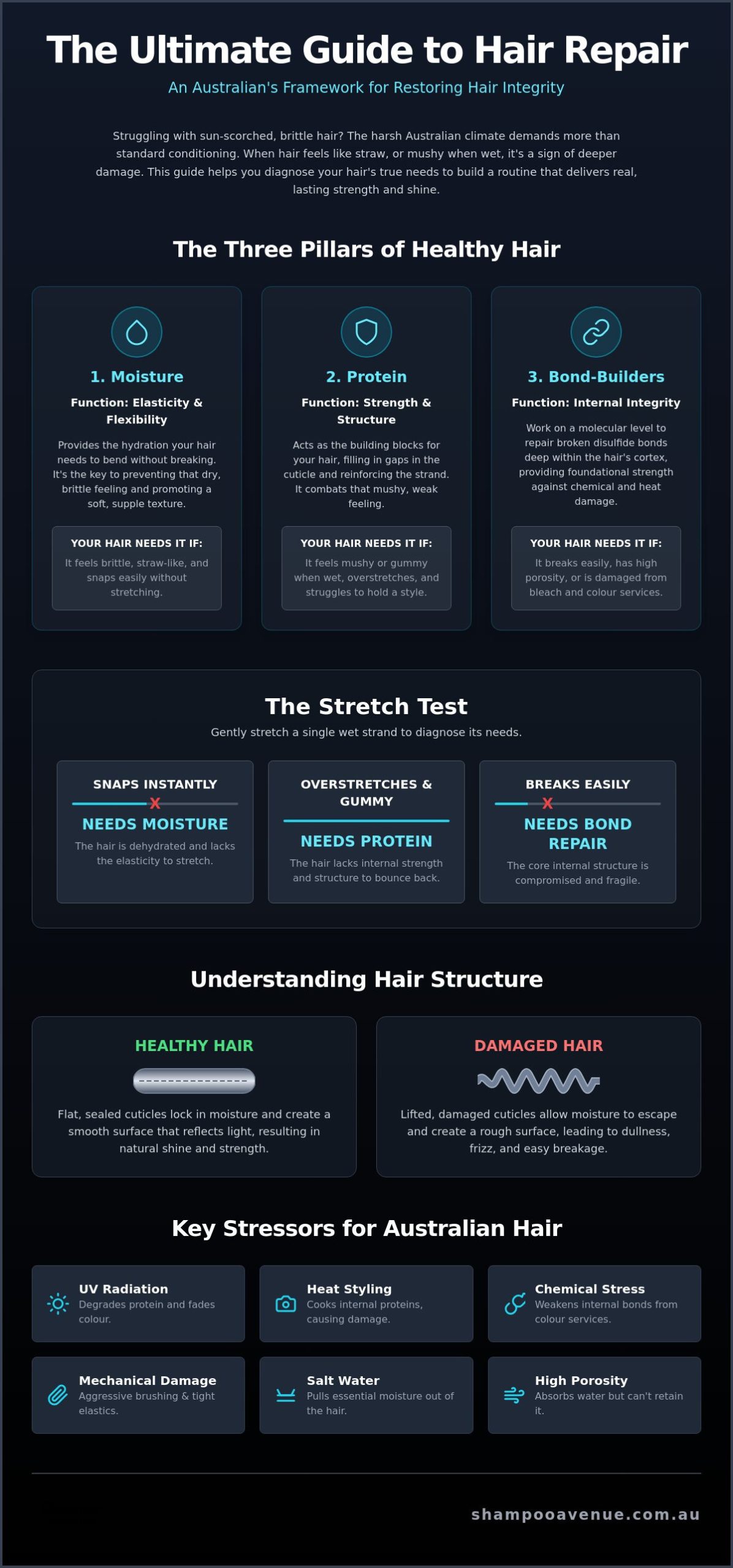
To understand why your hair feels like straw, you first need to look at the Science of Hair Structure. Think of the cuticle as the protective shingles on a roof. In healthy hair, these shingles lie flat, reflecting light and keeping moisture locked inside. When the cuticle is compromised, the inner cortex is exposed. This core is where your hair’s strength and elasticity live. Damage often leads to high porosity, where the hair absorbs water like a sponge but lacks the structural integrity to hold onto it, leaving it feeling “mushy” when wet and brittle when dry.
Common Causes of Hair Trauma in Australia
Living in Australia presents a unique set of challenges for our hair health. The intense UV radiation from our sun does more than just fade your colour; it actively degrades the protein bonds within the hair fibre. Salt water also plays a role, as it can pull essential moisture out of the strand through osmosis, leaving it feeling crunchy and depleted. Other common culprits include:
- Chemical Stress: Over-processing or using poor quality luxury hair colour can disrupt the hair’s pH balance and weaken its internal bonds.
- Mechanical Damage: Aggressive brushing, especially when the hair is wet and most vulnerable, or using tight elastics can cause micro-tears in the hair shaft.
- Heat Styling: Regular use of high-heat tools without proper protection literally cooks the proteins in your hair, leading to “bubble hair” and split ends.
By understanding these triggers, you can start to organise a more conscious routine that prioritises protection as much as it does restoration. Recognising that your hair is a delicate structure is the first step toward achieving a long-lasting, healthy glow.
The Three Pillars of Repair: Moisture, Protein, and Bond Builders
Effective hair repair is not a one-size-fits-all solution. Think of your hair health as a “Repair Triangle” consisting of moisture, protein, and internal bonds. Each pillar supports a different aspect of the hair’s structure. Moisture provides the elasticity that prevents snapping. Protein offers the strength to stop hair from feeling gummy. Bonds act as the internal integrity that holds the entire fibre together. When one side of this triangle collapses, your hair reflects that specific deficiency.
A common mistake is assuming that more is always better. If you use too much protein without enough hydration, you risk “protein overload,” which leaves hair feeling like stiff, brittle straw that breaks at the slightest touch. Conversely, “moisture overload” makes the hair feel mushy, limp, and unable to hold a style. Finding the sweet spot is the secret to a successful recovery. If you are unsure where to start, you can always chat with our friendly experts to get a personalised recommendation for your specific hair type.
You can diagnose your hair’s needs at home using the “Stretch Test.” Take a single strand of wet hair and gently pull it. If it snaps immediately without any give, your hair is likely dehydrated and needs moisture. If it stretches and stretches without bouncing back, or feels gummy between your fingers, it’s crying out for protein. If it breaks easily regardless of how it feels, your internal bonds are likely compromised.
Moisture: For Dehydrated, Brittle Hair
Thirsty hair is often the result of the intense Australian sun and salt water. It looks dull, tangles easily, and lacks that healthy shine. To fix this, look for ingredients like hyaluronic acid, fatty acids, and plant-based butters. These ingredients draw water into the strand and seal it in, restoring the “swing” and softness to your hair. Moisture is almost always the first step in any local repair journey.
Protein: For Weak, ‘Mushy’ Hair
When hair has been over-processed, the keratin structure becomes like a Swiss cheese full of holes. Keratin and amino acids act as a temporary filler for these gaps. You can learn more about balancing these elements in our guide to protein treatment hair. For those dealing with specific chemical recovery, we also have a detailed resource on how to repair chemically damaged hair.
Bond Builders: The Modern Miracle
Bond builders are different from traditional masks because they work on the disulphide bonds. These are the internal “ladders” that give hair its shape and permanent strength. While a mask coats the hair, a bond builder works to relink these broken ladders. This technology is essential for anyone who regularly lightens their hair or uses high-heat tools, as it addresses the damage that standard conditioners simply cannot reach.
Salon Treatments vs. Home Care: Which Does Your Hair Need?
Think of your hair health like your fitness routine. A salon service is the intense session with a personal trainer that pushes your limits and achieves the “heavy lifting.” Home care, on the other hand, is the daily movement and nutrition that maintains those results. While high-quality home products are essential, they are designed for maintenance rather than radical transformation. Professional hair repair treatments contain significantly higher concentrations of active ingredients that are often too potent for unsupervised home use.
The most important part of any repair journey isn’t the product itself, but the professional diagnosis. We see many clients who have spent hundreds of dollars on products that aren’t actually addressing their specific issue. A hairdresser can identify the subtle difference between chemical damage and environmental dehydration that a bathroom mirror might miss. If you notice your hair is snapping off in chunks, feels like it’s “melting” when wet, or has visible chemical burns, it’s time to put down the supermarket mask and see a specialist.
When you look at the cost-benefit analysis, one targeted salon treatment often provides more structural integrity than five cheap supermarket masks. Those budget options frequently rely on heavy waxes and silicones to create a temporary coating. In contrast, professional formulas work to actually bridge the gaps in your hair’s internal structure. It’s a more efficient way to invest in your hair’s long-term wellness. Understanding the key differences between your everyday products is also essential — our guide to the hair mask vs conditioner debate explains exactly how to use each one strategically for maximum repair results.
What Happens During a Professional Repair Service?
A professional service starts with a detailed consultation. We analyse your hair’s porosity and elasticity under specialised lighting to see exactly where the damage sits. Many of our in-salon hair repair systems are heat-activated, using controlled warmth to open the cuticle and allow the treatment to penetrate deep into the cortex. Finally, we apply a specialised “seal” that locks these restorative ingredients inside the strand, ensuring the benefits last through multiple washes at home.
The Role of At-Home Maintenance
Once you’ve had that professional reset, your home routine should focus on preservation. We recommend developing a “hair wardrobe” where you rotate your products based on how your hair feels each week. Stick to the “Goldilocks” rule: don’t use too much product, as this can lead to heavy build-up that blocks moisture. Because professional-grade products like Davines are highly concentrated, you only need a small amount to see results. This makes them more sustainable for both your hair and your wallet over time.
How to Organise Your Weekly Hair Repair Routine
Transforming your hair from straw-like to silky requires more than just a random collection of products; it requires a logical sequence. To see real results, you need to organise your routine so that each step builds on the last. Think of it as a weekly ritual of restoration that respects the unique challenges of our Australian environment. Whether you are recovering from a summer at the beach or a heavy lifting session at the salon, following a structured hair repair plan ensures no effort is wasted.
Step 1 is always about creating a clean slate. Use a clarifying shampoo once a week to remove mineral build-up from hard water and stubborn salt or chlorine. This process “opens” the cuticle, allowing your treatments to actually reach the inner cortex. Without this step, your expensive masks are simply sitting on top of a layer of film. Healthy hair begins with a balanced foundation, so ensure you prioritise scalp health to support new growth from the very first day.
Step 2 involves your targeted treatment. After rinsing your shampoo, take a moment to towel-dry your hair before applying your mask. If your hair is soaking wet, the water fills up the “pores” of the strand, leaving no room for the moisture or protein to enter. Apply your chosen treatment and leave it for the full recommended time. If you have ever wondered whether to reach for a deep treatment or your everyday conditioner at this stage, our detailed breakdown of hair mask vs conditioner for Australian hair wellness will help you make the right call every wash day. Step 3 is the seal. Always finish with a leave-in conditioner or oil. This acts as a protective barrier against the elements, locking in the goodness you’ve just applied.
The Night-Before Strategy
Your repair routine can actually start while you sleep. Applying a pre-shampoo oil the night before you wash can prevent “hygral fatigue,” which is the damage caused by the hair fibre swelling and contracting as it gets wet. This extra layer of protection keeps the strand stable. For your actual sleep environment, consider your accessories. Investing in a silk pillowcase is a simple way to reduce the friction that leads to mechanical breakage and frizz. Protective styling, such as a loose braid, also helps keep the hair cuticle smooth overnight.
Leave-In Care and UV Protection
In our climate, leave-in treatments are effectively the “day cream” for your hair. They provide a continuous source of hydration and protection throughout the day. Look for products that specifically include UV filters. The Australian sun can “bleach” the hair, breaking down the pigments and weakening the protein structure. Practising proper sun protection for the hair prevents this environmental degradation before it starts and is just as essential as any repair treatment in your routine. Finally, never skip a heat protectant if you plan on using a blow-dryer or iron. If you are ready to start your journey back to healthy hair, you can book your professional consultation with our team today.
Sustainable Hair Wellness: The Shampoo Avenue Approach
At Shampoo Avenue, we believe that beautiful hair is a natural byproduct of genuine health. We don’t just “fix” a problem for a single day; we cultivate long-term wellness. Our approach to hair repair is rooted in the belief that your hair’s integrity is the essential foundation for any luxury colour transformation. By focusing on the “lived-in” health of your strands, we ensure your colour looks vibrant and sophisticated for weeks, rather than fading away after a few washes. We see ourselves as your partners in this journey, helping you navigate the complexities of hair care with professional confidence and a down-to-earth perspective.
We choose to partner with Davines because they perfectly represent the intersection of high-performance chemistry and environmental integrity. This “Conscious Creative” approach allows us to deliver professional-grade results without compromising our ethical responsibility to the planet. We are dedicated to solving complex hair problems through expert diagnosis and a deeply personal level of care. Our team operates as a tight-knit family, and we bring that sense of belonging to every consultation we perform. We take pride in our craft, but our real joy comes from seeing the boost in confidence that healthy, restored hair brings to our clients.
The Davines Difference in Hair Repair
Davines formulas stand out because they move away from the harsh sulphates and parabens that often strip and further damage vulnerable hair. Instead, they utilise high-quality, sustainable alternatives that respect the hair’s natural pH. Their repair systems often feature “Slow Food Presidia” extracts, which are nutrient-rich ingredients sourced from small-scale producers to protect biodiversity. These botanicals provide the restorative power your hair needs to bounce back from the Australian sun and salt. When you choose a hair repair service with us, you are choosing a treatment that rescues your locks while actively supporting a more sustainable world.
Your Journey to Hair Recovery Starts Here
Ready to transform your hair? Visit us for a professional hair repair consultation and let’s create a personalised plan that restores your hair’s natural beauty and integrity.
Embrace a Future of Vibrant Hair Wellness
Restoring your hair doesn’t have to be a guessing game. By understanding the delicate balance between moisture, protein, and internal bonds, you can move away from temporary fixes and toward genuine structural integrity. Your hair’s needs will change with the seasons and your styling habits. A consistent routine that prioritises both professional “heavy lifting” and mindful home maintenance is the most effective way to manage hair repair in our demanding Australian climate.
Our team at Shampoo Avenue is here to help you solve those complex hair problems that feel overwhelming. As specialists in lived-in luxury blonde and an expert Davines professional salon, we focus on results that look incredible because your hair is fundamentally healthy. You deserve a routine that feels like a ritual of care rather than a chore. We are ready to help you navigate your unique hair story with empathy and skill.
Book your luxury hair repair transformation at Shampoo Avenue today and let us help you rediscover your hair’s natural strength. We can’t wait to welcome you into our community and start this restorative journey together.
Frequently Asked Questions
How long does it take to see results from hair repair treatments?
You will notice a cosmetic difference in shine and softness after just one application. However, true structural hair repair that improves elasticity and reduces breakage typically requires four to six weeks of consistent weekly treatments. This timeframe allows the restorative ingredients to build up within the hair fibre and create a lasting change in the hair’s overall integrity.
Can you actually fix split ends without cutting them?
No, you cannot permanently “heal” a split end once the hair fibre has physically separated. While some products can temporarily seal the ends together using special polymers, this is only a cosmetic fix that lasts until your next wash. The only way to stop a split from travelling further up the hair shaft and causing more damage is to book a professional trim.
Is it possible to over-repair your hair with too much protein?
Yes, you can absolutely over-treat your hair with protein, which leads to a condition known as protein overload. This happens when the hair becomes too stiff and loses its natural elasticity, causing it to snap easily when brushed. If your hair feels like dry straw despite using regular treatments, you likely need to pause the protein and focus on intensive hydration to restore balance.
What is the best way to repair hair that has been bleached too many times?
The most effective approach for over-bleached hair is a combination of bond-building technology and moisture-heavy professional masks. Bleaching strips the hair of its natural oils and breaks down the internal disulphide bonds. You need a targeted routine that relinks those bonds while replacing lost lipids to prevent the hair from feeling “mushy” or gummy when it is wet.
Do I need to change my hair repair routine during the Australian summer?
You should definitely adjust your routine to account for the increased UV exposure and salt water during the warmer months. The Australian sun can degrade hair proteins just as much as heat styling tools. We recommend increasing your use of leave-in conditioners with UV filters and always rinsing your hair with fresh water immediately after a swim to prevent salt-induced dehydration. Our 2026 summer survival checklist for sun protection for the hair covers exactly how to adapt your routine for the harshest months of the year.
How often should I use a deep conditioning mask for damaged hair?
Most people with moderate damage will see the best results by using a deep conditioning mask once a week. If your hair is severely compromised or has been recently lightened, you might increase this to twice a week for the first month. Always monitor how your hair feels; if it starts to feel limp or heavy, you might be over-moisturising and should scale back.
What is the difference between a hair mask and a hair repair treatment?
A standard hair mask usually focuses on the surface of the hair to provide immediate moisture and shine. In contrast, a professional hair repair treatment is designed to penetrate the cuticle and work within the cortex to reinforce the hair’s internal structure. Masks are great for weekly maintenance, but repair treatments are required when you need to address actual breakage or chemical trauma.
Can hard water in Australia cause hair damage that needs repair?
Yes, hard water contains high levels of minerals like calcium and magnesium that can build up on the hair shaft. This mineral “crust” prevents moisture from entering the hair, leading to a brittle texture and dull appearance over time. Using a clarifying shampoo or a chelating treatment once a fortnight is essential to remove this build-up and keep your hair receptive to restorative products.