

Protein for Hair Growth: Myth-Busting the Secret to Longer, Stronger Hair in 2026
What if the secret to longer hair has nothing to do with how fast it grows from your scalp? It is a frustrating reality for many of us that hair seems to hit a certain length and then simply stops. If you are tired of seeing brittle ends snap off every time you brush, you are probably searching for how to repair chemically damaged hair rather than just waiting for a miracle. We know the confusion of standing in the hair care aisle, wondering if your strands need a hit of moisture or a dose of protein to stop the cycle of breakage.
At Shampoo Avenue, we believe in a grounded approach to hair wellness that cuts through the marketing noise. You deserve to know the truth about how protein actually impacts your hair’s integrity and why it is the key to keeping the length you have. By reading on, you will discover the professional secrets to achieving the long, luscious locks you have been dreaming of. We are going to break down the science of the protein-growth link and share a professional-approved wellness routine that focuses on strength, sustainability, and real-world results.
Key Takeaways
- Understand that while protein doesn’t speed up biological growth, it is the ultimate tool for length retention by preventing brittle ends from snapping.
- Discover the professional secrets on how to repair chemically damaged hair by restoring the essential keratin building blocks within the hair’s cortex.
- Learn to spot the signs of protein overload, such as a straw-like feel or lack of shine, to ensure your hair stays supple rather than rigid.
- Organise a personalised wellness routine that matches specific protein weights to your hair’s porosity for maximum strength and shine.
- See why a luxury salon treatment acts as a vital reset, merging high-end colour with deep restorative care for long-term hair integrity.
The Science of Strands: Why We Link Protein to Hair Growth
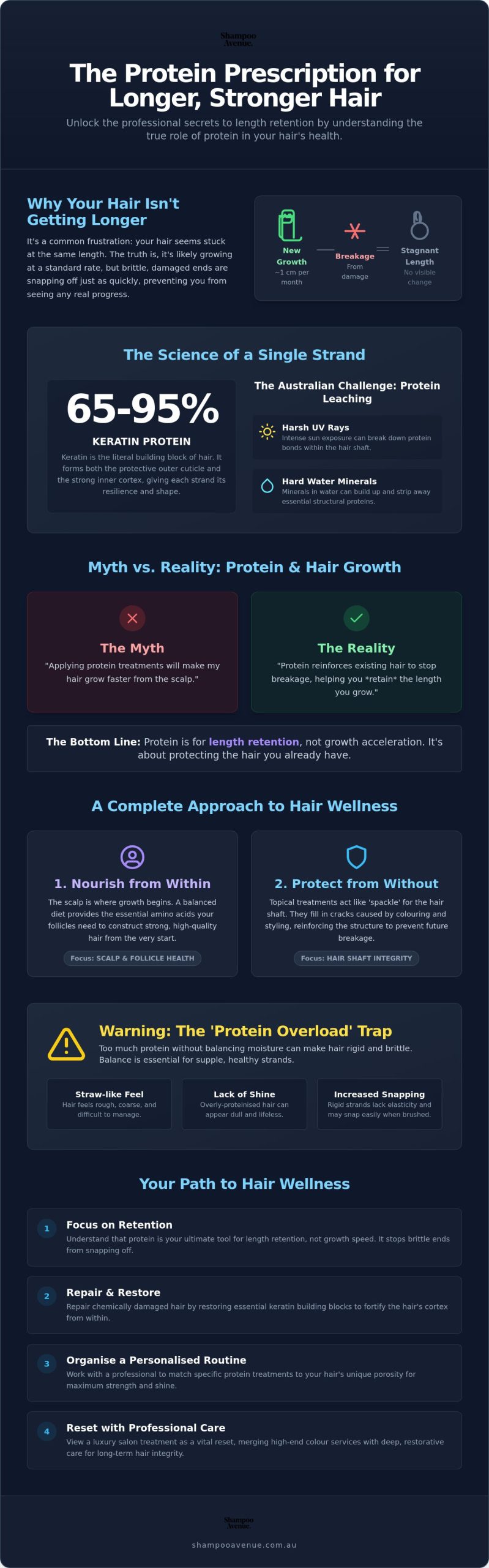
Your hair is more than just an accessory; it is a complex biological structure built almost entirely of protein. Specifically, each strand consists of 65-95% keratin. These are the literal building blocks that keep your hair looking lush and feeling resilient. Amino acids act as the foundation here, playing a vital role in the formation of both the hair cuticle, which is the protective outer layer, and the cortex, the thick inner layer that provides strength. Without a steady supply of these building blocks, your hair loses its ability to stand up to daily stress.
Living under the intense Australian sun creates a unique set of challenges for our hair integrity. The harsh UV rays, combined with the minerals found in hard water across many of our cities, can lead to a process known as “protein leaching.” This is where the structural proteins are essentially stripped away, leaving the hair shaft hollow and prone to snapping. When these bonds break, the hair becomes porous and fragile, leading many to wonder how to repair chemically damaged hair that feels like it has lost its soul. Viewing hair care as a wellness journey, rather than a quick fix, allows us to address these structural losses at the source. For a deeper understanding of diagnosing and treating these issues in our local climate, our Australian guide to hair repair provides a professional framework tailored to exactly these conditions.
Keratin 101: The Backbone of Your Hair
Visualise each strand of your hair as a sturdy, high-quality rope. This rope is woven from thousands of tiny protein fibres that work together to maintain its shape. When we use high-lift lighteners or intensive chemical perms, it is like we are slowly unravelling that rope from the inside out. The fibres begin to fray, the tension is lost, and the structure eventually fails. Keratin is a structural protein that provides strength and elasticity to every strand. By replenishing this protein, we are essentially re-weaving the rope, giving your hair the integrity it needs to stay long and strong.
The Protein-Growth Connection
Myth-Busting: Can Protein Treatments Actually Make Your Hair Grow Faster?
Let’s be real about the science of your strands. There is a massive misconception floating around that slathering on a protein mask will suddenly make your hair grow like a weed. It won’t. The biological rate of your hair growth is determined by your genetics, hormones, and overall health, not by what you put on the ends. Many clients come to us asking how to repair chemically damaged hair after a DIY bleaching session gone wrong, hoping for a miracle growth spurt. While we can’t change your DNA, we can change how much of that growth you actually get to keep.
The truth is that protein is the master of length retention. Have you ever felt like your hair has been stuck at the same length for six months? It’s a common frustration. Your roots are likely growing at the standard rate of about one centimetre per month, but your brittle ends are snapping off just as quickly. When you understand how to repair chemically damaged hair through targeted protein application, you stop losing length to the floor and start seeing it in the mirror. It is about keeping the hair you have already grown intact.
Scalp vs. Shaft: Where the Magic Happens
Your hair follicles live deep within your scalp, which is the only place where actual growth happens. This is why scalp health is the true foundation for any growth goals. Topical treatments, on the other hand, sit on the hair shaft, which is technically dead tissue. Think of protein treatments as “spackle” for your hair. They fill in the cracks and gaps caused by heat styling and colouring, reinforcing the structure so it can survive the day. They don’t speed up the engine, but they certainly fix the bodywork.
The Length Retention Secret
The math is simple: growth minus breakage equals your final length. If you can stop the breakage, you finally see the results of all that waiting. Using a professional protein treatment for hair acts like a safety net for your ends. This is especially vital for luxury blondes and colour-treated hair, which have inherently higher porosity and a higher risk of snapping. Natural hair often has its internal bonds intact, but once we introduce lightener, those bonds need external support to stay whole. If your ends feel like they’ve reached their limit, our professional hair repair treatments can help reset that balance and protect your progress.
The ‘Protein Overload’ Trap: Signs Your Hair Has Had Too Much
While we often focus on adding strength to our strands, it is entirely possible to have too much of a good thing. Protein overload occurs when the hair becomes too rigid and loses its natural elasticity. Instead of being strong and bouncy, the hair becomes stiff. It loses the ability to bend or stretch without breaking. If you are researching how to repair chemically damaged hair, you might be tempted to reach for every intensive mask on the shelf. However, over-applying protein without balancing it with hydration can actually lead to more damage in the long run.
Identifying this state early can save you from a lot of frustration. There are several clear signs that your hair has crossed the line into overload:
- The Texture: Your hair feels like straw or sandpaper, even when it is wet.
- The Shine Factor: Your strands look dull and matte, lacking that healthy, light-reflecting glow.
- The Snap: Hair snaps easily when you try to brush it or tie it back.
You can perform a simple ‘Snap Test’ at home to check your balance. Take a single strand of wet hair and gently stretch it. If the hair stretches slightly and bounces back, your protein-moisture levels are likely spot on. If it stretches and stretches without returning, you need more protein. However, if it snaps immediately with zero stretch, you are dealing with protein overload. Because every head of hair is unique, a professional diagnosis is crucial before you start an intensive regimen. We can help you determine exactly what your strands are craving.
Identifying Brittle Hair
It is easy to confuse ‘dry’ hair with ‘protein-damaged’ hair, but the solutions are very different. Dry hair simply lacks moisture and usually feels soft but frizzy. Protein-damaged hair feels hard and brittle. Coarse hair types are naturally more prone to overload because they already have a thick, protein-rich cortex. If you have been using cheap supermarket protein products, you might have a build-up of low-quality molecules that sit on the surface rather than penetrating the shaft. Rescuing this hair requires a deep, professional cleanse to strip away the build-up and start fresh. Understanding the full spectrum of hair repair strategies for damaged Australian hair can help you choose the right approach for your specific situation.
The Moisture-Protein See-saw
Think of your hair health as a see-saw. On one side, you have strengthening proteins; on the other, you have hydrating lipids and fats. To keep your hair resilient, you must balance these two forces. At Shampoo Avenue, we use Davines formulations because they achieve this balance naturally and sustainably. These professional treatments don’t just dump protein into the hair. They use high-quality conditioners to seal the protein inside while providing the slip and softness your hair needs to move freely. This holistic approach ensures your journey to how to repair chemically damaged hair is both effective and long-lasting.
How to Organise Your Australian Hair Wellness Routine
Step one is always assessing your hair’s porosity. This determines if your hair can even ‘hold’ the protein you are applying. If your hair is highly porous from bleaching, it has gaps that need filling. By learning how to repair chemically damaged hair through a structured wellness routine, you can enjoy the sun without the stress. Step two involves choosing the right ‘weight’ of protein. Not all proteins are created equal. Hydrolysed silk is feather-light for fine strands, while wheat and keratin provide the heavy-duty structural support needed for thicker or more compromised hair.
Protecting your hair’s protein structure from harsh Aussie UV rays is non-negotiable. The sun literally cooks the protein bonds in your hair, leading to that familiar brittle feeling. Integrating hair colour aftercare into your daily life ensures that your luxury blonde or rich brunette stays vibrant while the structure remains sound. For a complete seasonal strategy, our sun protection for the hair guide covers the latest 2026 UV filter updates and professional habits that act as colour insurance for your strands. Consistency is everything here.
Choosing the Right Treatment for Your Type
Fine hair is easily overwhelmed. It needs ‘light’ proteins like silk to avoid looking flat or greasy. On the other hand, chemically transformed hair requires deep-penetrating amino acids to reach the cortex and rebuild from within. We recommend Davines for these tasks because of their ethical, high-integrity ingredient sourcing. Their formulations respect the hair’s natural biology while delivering professional results without unnecessary weight.
At-Home Maintenance vs. Salon Wellness
There is a limit to what at-home masks can achieve. While they are great for maintenance, they lack the concentration of professional-grade infusions found in a salon. So, how often should you actually use protein? It is not an everyday thing. Over-use leads back to that ‘overload’ trap we discussed earlier. Aim for a weekly or fortnightly treatment at home, supported by a professional reset every six to eight weeks. This balance allows you to maintain a gorgeous ‘lived-in’ look that remains healthy and strong between visits.
Ready to give your hair the professional care it deserves? Explore our Hair Treatments and Hair Repair Treatments to find your perfect match and start your wellness journey.
Elevating Your Results with Conscious Professional Care
Understanding how to repair chemically damaged hair is one thing, but executing a structural overhaul requires the precision and high-grade tools only found in a professional setting. While at-home maintenance keeps the momentum going, a luxury salon experience acts as the ultimate reset for your strands. It’s a moment to pause and allow an expert to assess the damage that the naked eye might miss. At Shampoo Avenue, we don’t just see a hair problem; we see an opportunity to restore your confidence through a dedicated wellness journey. Our team merges high-end colour artistry with deep hair wellness to ensure your hair looks stunning and feels unbreakable.
We believe that your hair deserves a bespoke approach. There is no one-size-fits-all solution for protein application because your hair’s needs change based on your lifestyle and colour history. Our experts take the time to tailor every protein treatment to your specific situation, ensuring we fill the structural gaps without tipping you into overload. It’s this level of care that transforms a standard appointment into a pivotal step toward your long-term growth goals. We invite you to experience a consultation that looks beyond the immediate finish and focuses on the future of your hair.
The Davines Difference at Shampoo Avenue
Our commitment to your hair’s integrity is why we exclusively use Davines. Their formulations represent the perfect intersection of sustainable ethics and restorative power. When we perform a luxury blonde transformation, we aren’t just changing your shade; we are guarding the very fabric of your hair. This “Conscious Beauty” philosophy leads to better, more vibrant colour results because healthy hair holds pigment far more effectively than damaged, porous strands. By choosing ingredients that are as kind to the planet as they are to your scalp, we provide a restorative experience that you can feel good about.
Your Personalised Wellness Plan
When you sit in our chair, the process begins with a professional hair and scalp analysis. We look at everything from your scalp health to the elasticity of your ends. This data allows us to bridge the gap between your current hair and your “dream length” with a clear, actionable plan. We might suggest a specific series of Hair Treatments and Hair Repair Treatments or adjust your colour technique to better suit your hair’s porosity. We know that learning how to repair chemically damaged hair can feel overwhelming, but you don’t have to do it alone. Remember, healthy hair is a journey, not a destination. With the right partnership and a bit of patience, those long, luscious locks you deserve are well within reach.
Embrace the Future of Your Hair Wellness
Achieving your dream length in 2026 isn’t about chasing miracles; it’s about respecting the biological reality of your strands. We have explored how protein acts as the essential secret to length retention rather than a biological speed booster. By mastering the delicate balance between structural strength and hydrating moisture, you can finally move past the frustration of hair that seems to stop growing. Understanding the signs of protein overload and protecting your hair from the harsh Australian sun are the first steps toward lasting hair integrity.
If you are struggling with how to repair chemically damaged hair, remember that professional intervention is the most effective way to see a real change. At Shampoo Avenue, we are specialists in lived-in luxury blondes who prioritise the health of your hair above all else. As a sustainable Davines professional salon, our expert focus on hair wellness and repair ensures your strands stay as vibrant as your colour. We take pride in helping our community navigate their hair journeys with confidence and care.
Book your bespoke hair wellness consultation at Shampoo Avenue today and let us help you map out a path to the long, luscious locks you deserve. Your hair wellness is a journey, and we are here to support you every step of the way.
Frequently Asked Questions
Can protein treatments really help with hair growth?
Protein treatments help you keep your length by preventing breakage, but they don’t change the biological growth rate from your scalp. If your hair feels like it has stopped growing, it is likely snapping at the ends before it can reach a new length. Using targeted treatments is a key part of how to repair chemically damaged hair so that you can actually see the centimetres you are gaining every month.
How do I know if my hair needs protein or moisture?
Perform a wet stretch test to determine if you need protein or moisture. If your hair stretches and doesn’t return or feels mushy, you need protein to rebuild its structural integrity. If it feels rough, tangles easily, and has no stretch at all, you likely need a deep moisture treatment. Finding this balance is essential for maintaining a healthy, lived-in look.
Does eating more protein make your hair grow faster?
Eating a protein-rich diet supports the production of keratin, but it won’t force your hair to grow faster than its genetic limit. Your body prioritises vital organs before sending nutrients to your hair follicles. Unless you have a clinical deficiency, increasing your protein intake beyond a healthy, balanced level won’t result in a sudden growth spurt.
Is it possible to use too much protein on your hair?
Yes, using too much protein leads to a condition called protein overload, which makes the hair shaft rigid and brittle. Instead of being strong, the hair becomes stiff and snaps under the slightest pressure. It’s vital to rotate your strengthening products with hydrating conditioners to keep your strands supple and resilient against daily styling.
Can protein treatments fix split ends permanently?
No treatment can permanently fuse a split end back together once the hair shaft has frayed. Protein treatments can temporarily “glue” the cuticle down and prevent the split from travelling further up the strand, but a professional trim is the only way to remove them. Consistent maintenance and protection are the best ways to manage how to repair chemically damaged hair over time.
How often should I use a protein treatment for best results?
For most people, an intensive protein treatment is best used once every four to six weeks. If you use lighter, protein-enriched conditioners, these can be integrated into your fortnightly routine depending on your hair’s condition. Over-using high-concentration treatments can lead to build-up, so it’s always best to follow the specific guidance of your stylist.
What are the best types of protein for fine hair?
Fine hair thrives with lightweight proteins like hydrolysed silk, rice protein, or wheat protein. These smaller molecules penetrate the hair without adding excessive weight that can make fine strands look flat or greasy. Avoid heavy, oil-based keratin treatments for home use, as these are often too dense for more delicate hair types.
Will a protein treatment change my hair colour?
Professional protein treatments won’t change your hair colour; in fact, they often help your colour look more vibrant. By filling in the gaps in a porous cuticle, protein helps your hair “lock in” pigment, preventing your luxury blonde or brunette from fading too quickly. Just ensure you use salon-grade products to avoid any dulling mineral build-up.