

Mastering Protein Treatment for Hair: The Essential Guide to Strength and Repair
What if that rich, hydrating mask you’ve been layering on is actually making your hair more likely to snap? It sounds counterintuitive, but many of us mistake structural damage for simple dryness, leading to a cycle of over-moisturising that leaves hair feeling limp and “mushy” rather than strong. You’ve likely noticed your strands losing their bounce after a colour service or snapping during a simple morning brush. It’s a common struggle, but the solution isn’t just more oil; it’s about finding the right protein treatment hair needs to regain its resilience.
We agree that your hair wellness is the foundation for any style you love. This guide will help you discover how to restore your hair’s structural integrity and shine by mastering the delicate balance between protein and moisture. We’ll preview the latest 2026 trends in science-driven care, such as peptide infusions and biomimetic bond builders. You’ll gain a clear understanding of your specific hair porosity and learn how to transform brittle, damaged strands into a crown of healthy, resilient hair that feels as good as it looks.
Key Takeaways
- Understand how protein “fills the gaps” in your hair’s cuticle to restore strength and structural integrity from the inside out.
- Learn the simple elasticity test to determine if your strands need more moisture for stretch or a protein treatment hair boost for structural support.
- Spot the tell-tale signs of high porosity, such as hair that absorbs water instantly but remains limp, brittle, or loses its natural curl shape.
- Master the application process by removing product buildup first to ensure your repair treatment penetrates deeply into the mid-lengths and ends.
- Discover why prioritising long-term hair wellness with sustainable, professional-grade systems is more effective than reaching for temporary quick fixes.
What is a Protein Treatment for Hair?
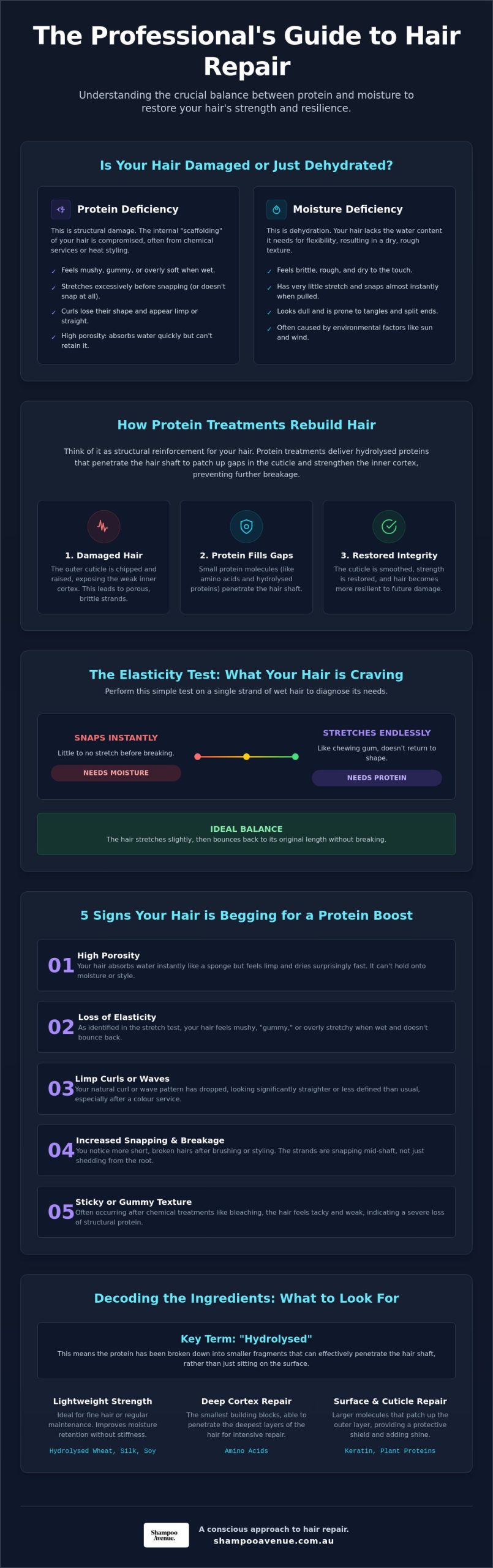
A protein treatment hair formula isn’t just another step in your routine; it’s a targeted rescue mission for your strands. At its core, these treatments are concentrated blends of keratin or plant-based proteins designed to patch up the structural damage caused by our daily lives. Think of it as a structural reinforcement for the hair’s internal architecture. While a daily conditioner sits on the surface to provide slip and shine, an intensive reconstructor dives deeper. It targets the hair cortex, the thickest layer of the hair shaft, where most of your hair’s pigment and strength live. As the outer cuticle becomes chipped or raised through styling, protein “fills the gaps” in these damaged areas, mimicking the natural structure to prevent further snapping.
The Building Blocks: Why Your Hair is Made of Protein
To understand why your hair feels fragile, you first need to look at what it’s actually made of. Your hair is an incredibly complex structure, composed of roughly 65% to 95% keratin protein. This tough, fibrous protein provides the literal backbone for every strand on your head. Understanding the role of hair keratin is vital because it explains why your hair responds the way it does to stress. Every time you reach for the straightener or book a high-lift blonde service, that heat and chemical process can “leach” these vital proteins away. As these building blocks disappear, your hair becomes more porous, absorbing water like a sponge but lacking the internal scaffolding to hold itself together. This loss of protein is why previously bouncy curls might suddenly look limp or “mushy” after a big colour change.
Common Protein Ingredients to Look For
Scanning the back of a bottle? Look for the word “hydrolysed.” This is a game-changer for hair health. It means the protein has been broken down into smaller fragments so they can actually penetrate the hair shaft rather than just sitting uselessly on top. Different sizes of protein serve different purposes in your hair wellness journey:
- Hydrolysed Wheat, Silk, and Soy: These are fantastic for adding lightweight strength and improving moisture retention without making the hair feel stiff.
- Keratin vs. Amino Acids: Keratin molecules are larger and excellent for surface repair, while amino acids are the tiny building blocks that can reach the deepest parts of the cortex.
- Plant-Based Alternatives: In our salon, we lean towards sustainable professional ranges like Davines that use innovative plant proteins. These ethical alternatives provide the same high-performance results without compromising our commitment to the planet.
Choosing the right blend ensures your hair remains supple. It’s about finding that sweet spot where the hair is strong enough to resist breakage but soft enough to move naturally.
Protein vs. Moisture: Which Does Your Hair Actually Need?
Have you ever spent a fortune on hydrating masks only to find your hair feels even heavier and more lifeless? It’s a common trap. We often assume dryness is the only enemy, but true hair health is a delicate scales act. While moisture provides your hair with its “stretch” and softness, a protein treatment hair provides the “strength” and internal scaffolding. When you over-moisturise without enough protein, you hit a state called hygral fatigue. This occurs when the hair cuticle expands and contracts too much, leading to a limp, “mushy” texture that lacks any bounce or life. Understanding the complex structure of hair helps us see why this balance is vital. Your hair isn’t just a solid tube; it’s a multi-layered fibre that requires both internal support and external flexibility to survive the harsh Australian sun.
The Elasticity Test: A Step-by-Step Guide
You don’t need a lab to figure out what your strands are craving. The “Stretch Test” is a simple way to check your hair’s elasticity at home. Follow these steps to get a clear picture of your hair’s current state:
- Take a single strand of wet hair (it’s best to do this after showering).
- Hold the strand firmly between your thumb and forefinger on both hands.
- Gently pull the hair to see how it reacts.
If the hair snaps almost instantly with no stretch, it’s brittle and crying out for moisture. If it stretches endlessly like chewing gum and doesn’t return to its original length, it’s “mushy” and needs protein. Ideally, the hair should stretch slightly and then bounce back to its original shape. If you find your hair is leaning towards that gummy, over-stretched feel, our team can help you recalibrate with one of our professional hair repair treatments designed to restore that lost structural integrity.
Protein and Moisture Comparison Framework
Maintaining this equilibrium between salon visits is the secret to long-lasting colour and style. The Australian climate can be particularly tough; the high UV levels often strip moisture, while chemical swimming pools can weaken protein bonds. Use this framework to identify your needs:
| Hair Feel | What it Needs | Common Symptoms |
|---|---|---|
| Snap-ready or Brittle | Moisture | Rough texture, tangles easily, snaps when brushing dry hair. |
| Stretchy or Limp | Protein | Feels gummy when wet, won’t hold a curl, looks flat and dull. |
Healthy hair requires a constant, rhythmic dance between these two elements. By paying attention to how your hair moves and feels, you can swap between hydrating oils and strengthening proteins as your environment changes. It’s about listening to what your hair is telling you rather than sticking to a rigid, unchanging routine.
5 Signs Your Hair is Begging for a Protein Boost
Spotting the warning signs of structural damage early can save you from a drastic chop later on. While we all love the look of a fresh colour or a sleek blowout, these processes can take a toll on the hair’s internal strength. If you’ve noticed your hair behaving differently lately, it might be trying to tell you that its protein levels are depleted. It isn’t always about how the hair looks in the mirror; often, the most telling signs appear when your hair is wet or during your morning styling routine.
Keep a close eye out for these five common indicators:
- High Porosity: Your hair drinks up water instantly in the shower but feels bone-dry and frizzy again before you’ve even finished your coffee.
- Loss of Curl Pattern: Waves that used to be bouncy now look limp and sad. If your curls won’t hold their shape no matter how much product you use, the “spring” in your hair’s architecture is likely broken.
- The “Mushy” Feel: This is a major red flag. If your hair feels gummy, stretchy, or like cotton wool when it’s wet, it’s a clear cry for a protein treatment hair intervention to rebuild those collapsed bonds.
- Excessive Snapping: Finding short, jagged bits of hair on your bathroom counter or shoulders is a sign of breakage, not shedding. This happens when the hair lacks the structural integrity to withstand even gentle tension. If you’re tired of seeing brittle ends snap off, understanding how to repair chemically damaged hair and stop the breakage cycle is the key to finally retaining your length.
- Pre-Colour Prep: If you’re planning a major transformation, like a Lived-In Luxury Blonde, your hair needs a protein treatment hair foundation. Stronger hair holds colour better and resists the damage of the lifting process. Working with a lived-in blonde specialist Phillip Island clients trust means your colour is built on a structurally sound base for a more vibrant, long-lasting result.
Understanding High Porosity Hair
Porosity refers to how well your hair can attract and retain moisture. When the cuticle is damaged, it stays permanently “open,” which allows moisture to escape as quickly as it enters. Research into macromolecules for hair health confirms that adding protein acts like a sealant for these gaps. By patching the holes in the cuticle, protein helps your hair stay hydrated for longer. Of course, great hair starts at the root. We always recommend looking at Scalp Health: The Essential Guide to ensure your foundation is just as strong as your strands.
The Danger of Protein Overload
It’s possible to have too much of a good thing. If you use intensive treatments too often, you might experience protein overload. This makes the hair feel stiff, straw-like, and surprisingly brittle. If your hair loses its natural movement and starts snapping when it’s dry, it’s time to hit the reset button. You can fix this by using a clarifying shampoo to remove the excess protein, followed by a deeply hydrating, moisture-focused conditioner. Balancing these two elements is the secret to hair that feels soft but remains incredibly resilient.
How to Use a Protein Treatment Safely and Effectively
Applying a protein treatment hair formula requires a bit more finesse than your standard Sunday afternoon mask. To get the best results, you need to start with a clean canvas. Product buildup from heavy silicones, oils, or even minerals in your shower water can create a barrier that prevents proteins from reaching the hair cortex. Always begin with a gentle clarifying wash to strip away these impurities. Once your hair is clean and damp, focus your application on the mid-lengths and ends. These are the oldest parts of your hair and have endured the most styling stress, so they’ll benefit the most from the structural reinforcement. Avoid the roots, as adding protein to healthy, new growth can lead to unnecessary stiffness or scalp congestion.
Timing is everything. While it’s tempting to think more time equals more strength, protein formulas are designed to work within a specific window. Leaving a reconstructor on for too long can actually be counterproductive, as the proteins can harden on the hair shaft and cause it to snap. Always follow the manufacturer’s instructions to the letter. Finally, remember the “Seal” step. Because protein can leave the hair feeling slightly firm, you must always follow up with a moisture-rich conditioner or a few drops of nourishing oil. This helps to soften the cuticle and lock in that newly found strength.
At-Home Maintenance vs. In-Salon Repair
A weekly at-home mask is a brilliant way to maintain your hair wellness between visits. However, if your strands are severely compromised from a recent colour transformation, a professional-grade reconstructor is the way to go. In the salon, we often use controlled heat to encourage the hair cuticle to lift slightly, allowing for deeper cortex penetration that you simply can’t replicate in your bathroom. For those looking to protect their luxury investment, checking out The Ultimate Roundup of Hair Colour Aftercare will give you a clear roadmap for keeping your mane in peak condition.
Frequency Guide: How Often is Too Often?
Your hair type dictates your schedule. If you have fine hair that hasn’t been chemically treated, a treatment every six weeks is usually plenty. For those with bleached or heat-damaged strands, a fortnightly session might be necessary to keep breakage at bay. Natural hair often benefits from a monthly “reset” to maintain curl definition and bounce. You should also adjust your routine based on the season. During a salty Australian summer, your hair might need more frequent protein to combat the weakening effects of UV rays and pool chemicals. If you’re unsure about your hair’s current needs, our team can provide personalised advice and professional hair repair treatments tailored specifically to your hair’s unique history.
The Conscious Approach to Hair Repair at Shampoo Avenue
At Shampoo Avenue, we believe that beautiful hair shouldn’t come at a cost to the environment or your long-term hair health. Our approach is rooted in the Davines philosophy, where sustainable beauty meets high-performance repair. We don’t believe in the “quick fix” culture that relies on heavy silicones to mask damage. Instead, we prioritise hair wellness as the essential foundation for every style we create. When you visit our San Remo studio, you’re not just getting a service; you’re embarking on a restorative journey that respects the integrity of your strands from the inside out.
This focus on structural integrity is why we’re so successful with Luxury Hair Colour Transformations. A high-quality protein treatment hair service is often the unsung hero behind those seamless, lived-in blondes. Without a strong internal structure, even the most expensive toner will wash out quickly as the hair struggles to hold onto pigment. By reinforcing the hair shaft before and during the colour process, we ensure your investment stays vibrant and healthy long after you leave the salon. It’s about creating a canvas that is as strong as it is beautiful.
Sustainable Strength: The Davines Difference
We choose Davines because their professional-grade repair systems utilise natural-origin ingredients that cleverly mimic the hair’s own keratin. This ethical choice means you don’t have to sacrifice performance for your values. Our stylists love creating “Hair Cocktails,” which are personalised blends of protein and moisture tailored to your hair’s unique needs on the day. We look at your hair’s history, its current porosity, and your future goals to ensure the balance is exactly right. This bespoke method prevents the stiffness of protein overload while providing far more strength than a generic off-the-shelf mask could ever offer. If you’re considering a colour change alongside your repair journey, our approach as a lived-in blonde specialist Phillip Island locals rely on ensures your hair is strong enough to achieve stunning, multi-tonal results without sacrificing its integrity. For those also navigating the transition away from permanent colour, our guide to grey blending for a natural, low-maintenance hair transition shows how a strong protein foundation supports a healthier, more graceful grow-out.
Booking Your Wellness Transformation
Ready to stop the snapping and start your repair journey? We encourage you to book a professional consultation at our boutique studio for a comprehensive porosity test. We’ll take the guesswork out of your routine by identifying exactly what your hair is craving. Whether we’re integrating a protein treatment hair plan into your regular maintenance or performing a deep-level reconstruction before a major colour change, we’re here to help. Our team is passionate about solving hair problems through expert craft and genuine care. Let’s work together to create a bespoke hair plan that restores your shine and leaves your hair feeling resilient, soft, and completely revitalised.
Embrace Your Hair’s Strength and Shine
You now have the tools to identify whether your strands are craving a protein treatment hair boost or a deep hydration hit. Remember that healthy hair isn’t just about soft texture; it’s about the internal scaffolding that allows your colour to pop and your curls to bounce. By mastering the simple elasticity test and recognising the signs of high porosity, you can move away from temporary fixes and towards genuine hair wellness. It’s time to stop the cycle of breakage and start building a resilient foundation for your future styles.
As an official Davines Professional Salon, we are specialists in hair repair and wellness. Our team of expert lived-in blonde stylists understands that every luxury transformation must be built on a foundation of structural integrity. Don’t let brittle ends or limp strands hold you back from the look you love. We’re here to provide the professional expertise and ethical products your hair needs to thrive. Book your bespoke Hair Wellness Transformation at Shampoo Avenue today. We can’t wait to help you rediscover the natural resilience and beauty of your hair.
Frequently Asked Questions
Can protein treatments cause hair loss?
No, protein treatments don’t cause hair to fall out from the follicle. However, if you experience severe protein overload, your hair can become so brittle that it snaps off at the mid-lengths or near the root. This breakage can mimic hair loss, but it’s actually a structural failure of the hair fibre rather than a scalp health issue.
How long do the results of a salon protein treatment last?
Typically, you can expect the results of a professional protein treatment hair service to last between four and six weeks. This timeframe depends heavily on how often you wash your hair and the quality of your home care routine. Using sulphate-free cleansers and avoiding harsh minerals helps maintain the structural “patches” for as long as possible.
Is a protein treatment the same as a keratin treatment?
No, they serve different purposes. A protein treatment focuses on internal repair and strengthening the hair’s cortex to prevent breakage. In contrast, what’s commonly called a “Keratin Treatment” in Australian salons is usually a smoothing or straightening service. These use chemicals to alter the hair’s texture and reduce frizz for several months rather than just repairing damage.
Can I use a protein treatment on natural, uncoloured hair?
Absolutely. Even if you don’t colour your hair, environmental factors like the intense Australian sun or frequent heat styling can deplete your natural keratin levels. Natural hair with high porosity or very fine textures often benefits from the added support and volume that a targeted protein boost provides to the hair’s internal architecture.
What happens if I leave a protein treatment in my hair overnight?
Leaving a treatment in overnight is generally a bad idea. As the protein dries, it can harden on the hair shaft, making the strands incredibly stiff and prone to snapping when you move in your sleep. It’s always best to stick to the recommended ten to twenty minutes to avoid the risk of sudden breakage.
How do I know if my hair is protein sensitive?
You’ll know your hair is protein sensitive if it feels stiff, dry, or “crunchy” even after you’ve used a hydrating conditioner. This is quite common in low-porosity hair, where the cuticles are tightly closed and don’t allow large molecules in. If your hair reacts this way, you should opt for lighter silk proteins or tiny amino acids instead.
Should I use protein before or after hair colouring?
We recommend using a protein treatment hair formula about a week before your colour appointment. This preps the “canvas” by filling in gaps in the cuticle, which helps the colour molecules distribute more evenly. It also ensures your hair is strong enough to handle the chemical process, leading to a more vibrant and long-lasting result. If you’re moving away from permanent colour and exploring grey blending as a gentler, low-chemical alternative, building up your hair’s protein levels beforehand is especially important for a smooth, healthy transition.
Can I DIY a protein treatment with eggs or yoghurt?
While it’s a popular home remedy, food-grade proteins like eggs or yoghurt aren’t effective for hair repair. The protein molecules in these ingredients are simply too large to penetrate the hair shaft. Professional formulas use hydrolysed proteins, which are scientifically broken down into tiny fragments that can actually fit into the damaged areas of your hair.