

Hair Mask vs Conditioner: The Australian Guide to Luxury Hair Wellness in 2026
Could your morning shower routine be the very thing standing between you and the effortless, salon-quality shine you’ve been craving? It’s a common frustration for many of us living under the harsh Australian sun. You invest in a luxury colour transformation, only to find your ends feeling like straw just a few weeks later. When it comes to the hair mask vs conditioner debate, many people assume these products do the same job. However, using them interchangeably often leads to either persistent dryness or heavy, limp strands from product buildup.
We understand that you want a simplified routine that actually delivers results without the guesswork. You deserve a hair care ritual that feels like a moment of genuine wellness rather than another chore on your list. This guide will show you how to distinguish between daily moisture and deep restorative care to achieve professional softness at home. We will explore how to use these tools as targeted architects for your hair’s internal health. You’ll learn exactly which product solves your specific concerns, from salt-water frizz to chemical breakage, ensuring your hair stays as vibrant and healthy as the day you left the salon.
Key Takeaways
- Understand the fundamental differences in the hair mask vs conditioner debate, specifically how each product addresses the unique challenges of the Australian climate.
- Discover the science behind molecular size and why conditioners provide surface protection while masks act as internal architects for deep repair.
- Learn how to time your treatments perfectly, moving beyond the “once a week” rule to suit your hair’s specific level of colour damage or dryness.
- Master the step-by-step home wellness ritual that combines these products to achieve professional softness without the heavy feeling of product buildup.
- Identify why professional-grade solutions like Davines are essential for protecting the longevity and shine of luxury lived-in blonde transformations.
Hair Mask vs Conditioner: Understanding the Basics of Hair Hydration
Choosing between a hair mask vs conditioner often feels like a guessing game, especially when your ends feel like straw after a weekend at the beach. In Australia, our hair faces extreme UV exposure, salt air, and relentless wind. These environmental factors don’t just sit on the surface; they actively deplete the moisture levels within the hair fibre. Understanding the distinction between these two products is vital for anyone maintaining a luxury colour transformation or a lived-in blonde look. It is the difference between a quick fix and long-term hair health.
Your hair’s porosity, which is its ability to absorb and retain moisture, should guide your choice. High-porosity hair, often found in those who love frequent lightening services, has a raised cuticle that allows moisture to escape easily. This hair type requires more frequent, intensive care. Conversely, low-porosity hair can be resistant to moisture but prone to product buildup if rich treatments are used too often. By adopting a “Daily vs. Weekly” mindset, you can tailor your routine to provide exactly what your strands need without causing heaviness.
What is a Hair Conditioner?
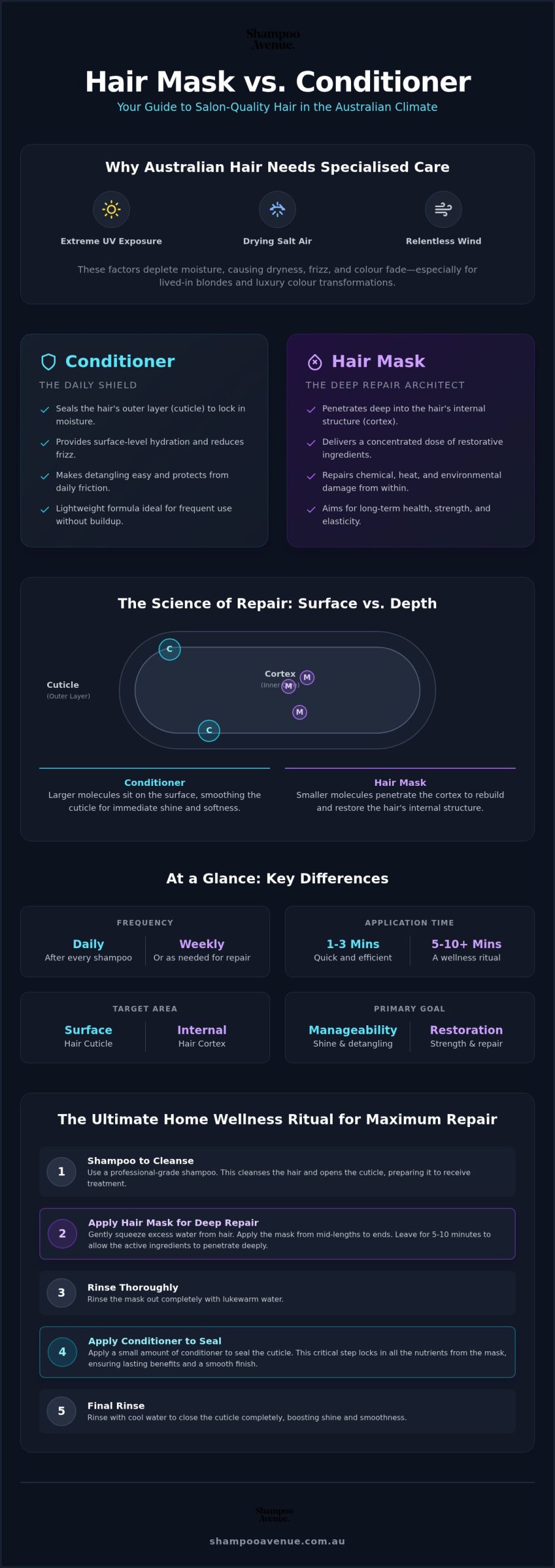
Think of a hair conditioner as your daily shield. Its primary role is to seal the hair’s outermost layer, known as the cuticle, immediately after shampooing. By smoothing these microscopic scales, it locks in moisture, reduces frizz, and makes detangling much easier. For those with fine hair, a lightweight conditioner provides enough slip to prevent breakage during styling without weighing the roots down. It is a surface-level specialist designed for frequent use to keep your hair manageable, shiny, and protected from daily friction.
What is a Hair Mask?
While a conditioner handles the outside, a hair mask is the deep-dive architect for the internal structure. These treatments feature smaller molecular structures and a higher concentration of active ingredients, allowing them to penetrate deep into the cortex. This is where the real repair happens for chemical damage or extreme dehydration. Applying a mask is more than just another step; it’s a wellness ritual. Because masks require five to ten minutes to sink in, they offer a chance to slow down while the restorative ingredients work to rebuild the hair’s strength and elasticity from the inside out.
The Science of Repair: How Masks and Conditioners Work Differently
To truly master the hair mask vs conditioner balance, we need to look beneath the surface. While both products aim to improve the feel of your hair, they operate on entirely different molecular levels. Conditioners typically contain larger molecules designed to hug the outside of the hair shaft. In contrast, high-quality masks are formulated with smaller molecular structures that can bypass the cuticle to reach the inner layers. This distinction is vital because a product that only sits on top cannot fix the internal structural damage caused by our harsh Australian UV rays or beach-day salt exposure.
The secret to these transformations lies in pH levels. When you shampoo, the slightly alkaline environment causes the hair cuticle to swell and open. This is the perfect moment for treatments to enter. Research into hair cosmetics and conditioning science shows that conditioners and masks are formulated with an acidic pH to help seal those cuticles back down. Professional ranges, like Davines, use high-grade lipids and refined ingredients to achieve this without the heavy, suffocating silicones found in cheaper supermarket alternatives. Lower-end products often rely on “filler” silicones that create a fake shine while actually blocking genuine moisture from entering the hair fibre.
Conditioners: The Daily Cuticle Sealant
Daily life in Australia is tough on your hair. Wind, humidity, and even the friction from your pillow create negative charges that lead to static and flyaways. A professional conditioner acts as a neutraliser, smoothing these charges and providing a protective barrier against environmental stressors. It’s your first line of defence. If you skip this step, the cuticle remains slightly raised, which accelerates moisture loss and eventually leads to more intensive hair repair needs down the track. It’s about maintaining that silky, manageable base every single day.
Hair Masks: The Internal Cortex Architect
When your hair has been through a luxury blonde transformation or a significant colour change, the internal bonds need more than just a surface smoothing. Masks deliver a concentrated load of lipids and essential proteins directly to the cortex. The cortex is the engine room of hair strength, providing the elasticity and structural integrity that prevents snapping. Integrating a protein treatment hair ritual once a week helps rebuild these broken bonds. This deep-level architecture is what keeps your lived-in colour looking vibrant and expensive rather than dull and brittle. If you’re unsure which restorative ritual your hair needs most, our team at Shampoo Avenue can help you identify the perfect balance for your unique hair profile.
Key Differences: Comparing Texture, Frequency, and Results
How do you know if your hair is actually “hungry” for a mask or just needs a standard condition? Look for signs of “environmental fatigue.” If your hair feels brittle, snaps easily when wet, or looks dull despite using good products, it’s likely craving the internal repair only a mask can provide. If your hair is simply difficult to brush or feels a bit dry on the surface after a windy day, a high-quality conditioner will usually do the trick. Understanding this distinction prevents you from over-treating your hair and causing the heavy, limp feeling that comes from product buildup.
Side-by-Side: Formulation and Application Time
Respecting the chemistry of your products is the quickest way to see real results. A common mistake is thinking that leaving your conditioner on for twenty minutes will transform it into a deep treatment. It won’t. The molecular structure of a conditioner is designed for a three-minute window to seal the cuticle. According to hair cosmetics research, the viscosity of a product often dictates how well it can cling to the hair fibre during these treatment times. Masks require that full ten-minute ritual because their ingredients need time to travel past the surface and into the hair’s core.
Choosing Based on Your Hair’s Specific Problems
Our local climate presents unique challenges that require a tailored approach. For managing frizz during humid Australian summers, a mask wins every time by hydrating the hair from within so it doesn’t seek moisture from the air. In our coastal lifestyle, sun protection for the hair is non-negotiable. Using a mask after a day at the beach helps replenish the lipids stripped by salt and UV rays. Some masks are even designed for scalp health, acting as a soothing treatment for dry, sun-exposed skin. By matching the product to your specific problem, you ensure your routine remains effective without becoming overly complicated.
How to Use a Hair Mask and Conditioner for Maximum Repair
One of the most frequent questions we hear in the salon is whether you should use both products during the same wash. The golden rule of the hair mask vs conditioner debate is simpler than you might think: you rarely need both in a single session. Because a high-quality mask is designed to be an intensive, all-in-one treatment, it usually contains enough sealing agents to close the cuticle on its own. Using a conditioner immediately after a mask is often redundant and can lead to the very product buildup that leaves luxury hair looking flat and lifeless.
To get the most out of your investment, think of your masking day as a dedicated wellness ritual. It is a time to slow down and give your strands the focused attention they deserve. The way you apply these products is just as vital as the ingredients themselves. If you are ready to elevate your home care, explore our range of professional hair care products designed to withstand the unique pressures of the Australian climate.
The Step-by-Step Masking Routine
Success starts with a clean canvas. Begin by cleansing with a professional shampoo to remove environmental pollutants and gently prep the cuticle. Once rinsed, the most crucial step follows: towel-drying. Wet hair acts like a full sponge; if your strands are dripping, there is no room for the mask’s restorative oils to penetrate. Gently squeeze out excess moisture before working a 20-cent piece size of product through your mid-lengths and ends. Use a wide-tooth comb to ensure even distribution. For a true wellness boost, wrap your hair in a warm towel for ten minutes to help the ingredients sink deep into the cortex.
Common Mistakes to Avoid in Your Wellness Routine
Even the best products can underperform if applied incorrectly. Avoid the temptation to apply your mask to the roots, as this is the quickest way to end up with oily hair by the next morning. Unless you are using a specialised scalp treatment, keep the rich formulas to the areas that need it most. Another common pitfall is using too much product. Professional formulas are highly concentrated, so a little goes a long way. Finally, always finish with a cool rinse. While a hot shower feels relaxing, cool water is the ultimate salon secret for sealing the cuticle and creating that signature high-shine finish. These small adjustments transform a basic chore into a professional-grade repair session.
Elevating Your Routine with Professional Davines Solutions
Maintaining the integrity of your hair between salon visits requires more than just a random selection of products. At Shampoo Avenue, we exclusively trust Davines to protect your luxury hair colour investment. Whether you are rocking a lived-in blonde or a deep, natural brunette, the products you choose in the hair mask vs conditioner debate will determine how long that “just-stepped-out-of-the-salon” feeling lasts. Professional ranges are specifically designed to work in harmony with the chemical processes used during your transformation, ensuring that moisture is replenished without stripping away the pigment.
One of our most loved solutions is the Davines “OI” range. It is a universal powerhouse for shine and softness, utilising Roucou oil to provide an extraordinary sensory experience. Because every head of hair is a unique landscape, we often suggest mixing and matching different lines. You might use a lightweight conditioner for your daily needs but switch to a targeted mask for those moments when the Australian sun has been particularly harsh. This bespoke approach ensures you are solving specific problems like frizz or breakage without overwhelming your scalp’s natural balance.
Why Sustainable Luxury Matters for Hair Health
The Davines “Sustainable Beauty” philosophy is at the heart of everything we do. It’s a belief that professional results should never come at the expense of the planet or your personal well-being. Natural, ethically sourced ingredients outperform synthetic fillers in the long run because they mimic the hair’s own biological structure. High-quality ingredients strengthen the hair’s foundation from the inside out, which significantly reduces the frequency of intensive hair repair sessions needed to fix preventable damage. When you choose sustainable luxury, you are choosing a routine that is as kind to your conscience as it is to your curls.
Finding Your Perfect Match at Shampoo Avenue
Embrace Your New Ritual for Radiant Hair Wellness
Mastering the balance of a hair mask vs conditioner doesn’t have to be a source of confusion. By now, you understand that these two products play distinct, vital roles in your hair care story. Your conditioner provides the essential daily protection your cuticle needs to withstand the Australian wind and sun, while your weekly mask acts as a deep-level architect to repair internal damage from the inside out. When you choose professional, sustainable solutions, you aren’t just managing frizz; you’re actively preserving the life and vibrancy of your luxury colour.
At Shampoo Avenue, we’re proud to be an exclusive Davines professional salon partner. Our tight-knit team specialises in lived-in luxury blonde and complex colour transformations, always with an expert focus on scalp health and long-term hair wellness. We’re here to help you move beyond generic routines and into a space where your hair truly thrives through every season. We invite you to book your luxury colour transformation and wellness treatment at Shampoo Avenue and experience the difference of personalised, professional care. We can’t wait to welcome you into our salon family and help you achieve the soft, luminous hair you deserve.
Frequently Asked Questions
Can I use a hair mask instead of a conditioner every time I wash?
No, you shouldn’t use a mask every time because it can lead to heavy product buildup. While it’s tempting to reach for the richest product every wash, the hair mask vs conditioner debate is really about balance rather than replacement. A conditioner is designed for daily surface smoothing, whereas a mask provides deep internal repair. Using a mask too often can make your hair feel limp and oily, so stick to your daily conditioner and reserve the mask for your weekly wellness ritual.
Do you put hair mask on wet or dry hair for the best results?
You should always apply your treatment to clean, towel-dried hair for the most effective results. If your hair is soaking wet, the water fills the strands and repels the restorative oils in the mask. By gently squeezing out excess moisture first, you create space for the active ingredients to penetrate the hair fibre rather than just sliding off the surface. Dry hair isn’t ideal as the cuticle isn’t prepped to absorb the treatment as deeply.
Should I use conditioner after a hair mask to seal the cuticle?
You don’t need to use a conditioner after a professional mask. High-quality treatments, like those from Davines, are formulated with a specific pH to close and seal the hair cuticle once the repair work is done. Adding a conditioner on top is usually redundant and can leave your hair feeling weighed down or flat by the end of the day. Trust the mask’s formulation to do the job of both repairing and sealing in one step.
How often should I use a hair mask on chemically damaged hair?
For hair that has undergone chemical transformations, using a mask once or twice a week is ideal. This frequency helps rebuild the internal bonds that are weakened during lightening services. Deciding on frequency in the hair mask vs conditioner routine depends on your damage levels, but once a week is the sweet spot for most. If your hair feels particularly brittle after a weekend at the beach, a second application can help restore lost lipids.
Will a hair mask make my fine hair feel greasy or flat?
A mask won’t make fine hair flat if you select a lightweight professional formula and keep it away from your roots. Focus the product entirely on your mid-lengths and ends where the damage usually sits. Using a 20-cent piece size and rinsing thoroughly with cool water ensures you get the strength and shine without losing your natural volume. Avoid heavy, oil-based masks designed for thick or curly hair types to keep your style bouncy.
Can I leave a hair mask in overnight for extra repair?
Leaving a mask in overnight is rarely more effective than a focused twenty-minute session. Most professional formulas stop working once the hair has absorbed what it needs. In fact, keeping hair damp for too long can cause the fibre to swell and weaken over time, a condition known as hygral fatigue. It’s much better to follow the recommended ritual for a healthy, balanced result rather than sleeping in a damp towel.
What is the best way to use a hair mask for lived-in blonde hair?
The best approach for lived-in blonde hair is to focus on a moisture-rich mask that protects your colour investment. Because blonde hair is more porous, it loses moisture quickly in the Australian heat. Use a wide-tooth comb to distribute the product evenly through your lightened sections. This ensures every strand is coated in the restorative lipids needed to keep your blonde looking creamy and bright while preventing the straw-like texture common with environmental damage.
How much hair mask should I actually be using per application?
You only need a 20-cent piece size for most applications. Professional products are highly concentrated, meaning a small amount contains a significant load of active ingredients. Using half a jar won’t make your hair twice as soft; it will just make the rinsing process much harder and lead to unnecessary product buildup. Start small and add a tiny bit more only if your hair is exceptionally long or thick. This approach ensures your luxury products last longer and perform better.