

Fix Uneven Hair Colour: Professional Correction Guide
You’ve spent hours carefully applying a new shade at home, only to step out of the shower and find “hot roots” glowing under the bathroom light while your ends remain stubbornly dark and patchy. It’s a heart-sinking moment that many of us have faced, leaving your hair feeling dry and your confidence a little shaken. We understand that your hair is a vital part of your identity. Seeing it look “fried” or banded feels like a personal setback rather than just a simple beauty mishap.
The good news is that learning how to fix uneven hair colour is about more than just layering on more pigment. It requires a thoughtful, wellness-centred approach that respects the integrity of your strands and restores their natural shine. In this guide, we’ll explore why your colour ended up uneven, from the science of hair porosity to the impact of previous treatments. We will also preview the professional correction steps used in luxury salons, including the latest 2026 bond-building technologies from brands like Wella and Matrix. You’ll walk away with a clear plan to restore a seamless, natural-looking finish and the knowledge to keep your hair healthy and vibrant for the long term.
Key Takeaways
- Uncover the common application errors, like “hot roots” and banding, that lead to a patchy or multi-toned finish.
- Learn how your hair’s porosity determines how it drinks up pigment and why this causes certain sections to look darker than others.
- Discover the essential first steps on how to fix uneven hair colour at home without causing further damage to your strands.
- Understand the professional “Fill and Neutralise” method used to restore depth and achieve a seamless, natural-looking result.
- Explore our unique wellness-centred approach that balances high-end colour results with the long-term health of your hair and scalp.
Identifying the Patchwork: Why Your Hair Colour Looks Uneven
Uneven hair colour isn’t just one single problem. It’s a spectrum of results that didn’t quite go to plan, ranging from subtle horizontal stripes to roots that seem to glow under the light. These issues usually stem from how the colour was applied, how the hair was sectioned, or how new chemicals interacted with old ones. Understanding these patterns is the first step in learning how to fix uneven hair colour without causing more stress to your strands.
Common culprits often include overlapping previous colour, inconsistent application, or improper sectioning. If you’ve tried to colour your hair at home, you might have missed spots at the back or applied too much product in one area. This creates a “patchwork” effect that looks disjointed and flat. Distinguishing between simple patchiness and structural “banding” is vital for a successful correction.
The “Hot Roots” Phenomenon
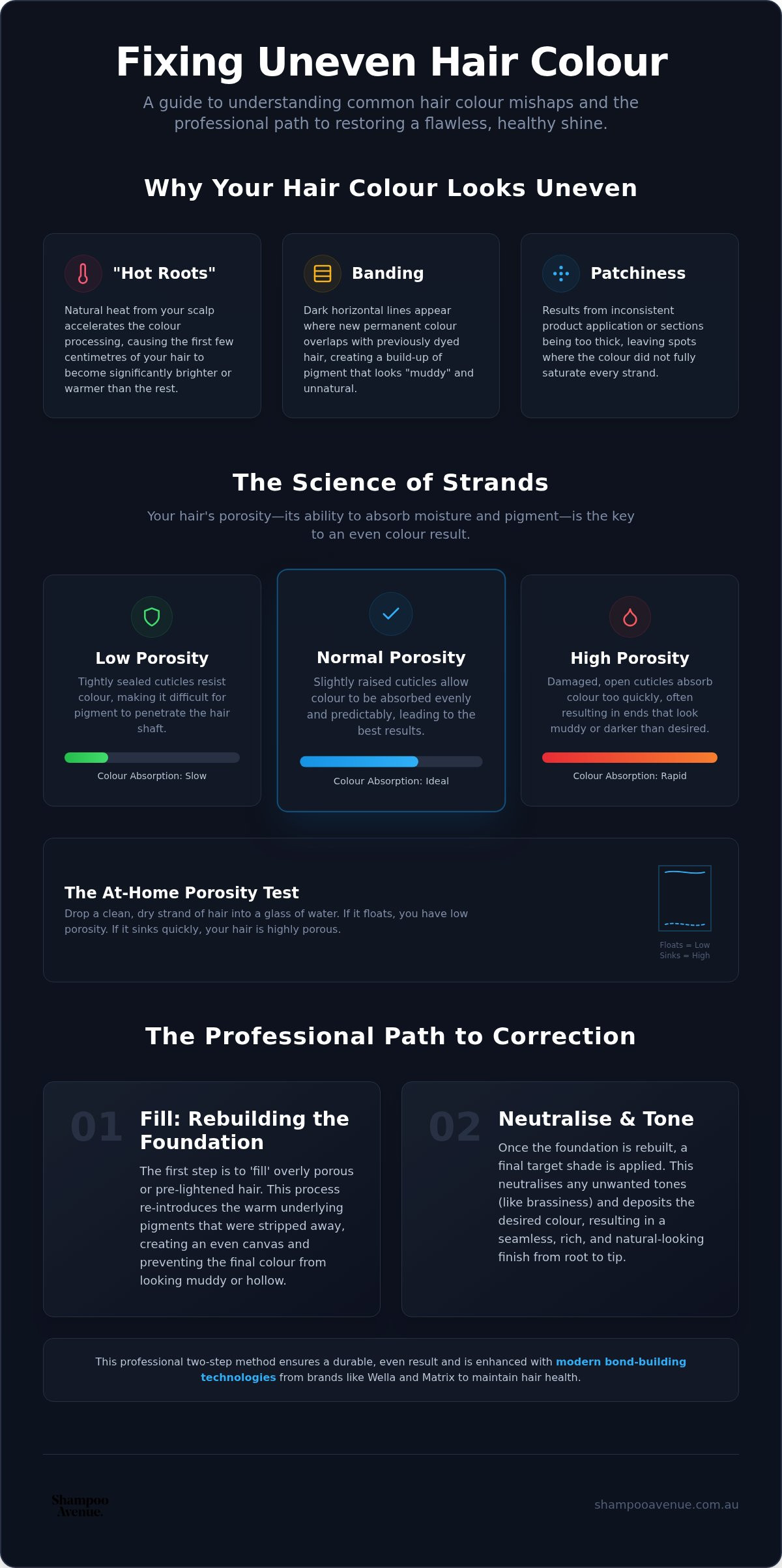
Why do the first couple of centimetres often look so much brighter or warmer? This is known as “hot roots”. Your scalp emits natural body heat, which acts as a powerful catalyst during the chemical process. This warmth speeds up the reaction near the skin, while the hair further down the shaft stays cooler and processes more slowly. The science of hair coloring explains that temperature significantly impacts how pigment develops. If your roots look orange or bright yellow against darker mid-lengths, you’ve experienced this thermal boost. It’s a common sign that the developer used was too strong for the “virgin” hair near the scalp.
Banding and Overlapping
While hot roots are about heat, banding is about hair history. It occurs when you apply new permanent colour over hair that already contains old dye. This creates a visible, dark horizontal line where the two products overlap. Each time you “refresh” your ends with permanent box dye, you’re adding another layer of pigment that becomes harder to remove. This build-up often makes the ends look “muddy” or overly dark compared to the rest of the hair.
Patchiness, conversely, is usually an application error. If your hair sections were too thick, the product couldn’t saturate every strand, leaving dry spots where your old colour still peeks through. Identifying whether you have a build-up of old product or just an uneven application helps us map out the best restorative path for your hair. We look for these specific patterns during a consultation to ensure we aren’t just covering up the problem, but actually solving the underlying cause of the unevenness.
The Science of Strands: How Porosity Impacts Colour
If you’ve ever wondered why your mid-lengths look darker than your roots after a single application, the answer usually lies in your hair’s porosity. This term describes your hair’s ability to absorb and retain moisture and pigment. Think of your hair cuticle as a series of protective shingles on a roof. When these shingles are flat and tight, your hair has low porosity. It’s healthy, but it can be stubborn and resist colour altogether because the pigment can’t get inside.
On the other hand, high-porosity hair is often the result of previous damage. The cuticles are raised or missing, leaving the inner cortex exposed. This hair acts like a dry sponge; it drinks up colour far too fast. This is a primary reason why damaged ends often turn out “muddy” or much darker than the rest of the head. Understanding these internal factors is the real secret to how to fix uneven hair colour effectively. A healthy scalp health routine is the foundation here, as it ensures the new hair growing in is resilient and structurally sound from the very beginning.
The Elasticity and Porosity Test
Before you attempt another colour application, you need to know what you’re working with. You can perform a simple “float test” at home by dropping a few strands of clean, dry hair into a glass of water. If the hair floats on the surface, you have low porosity. If it sinks immediately, your hair is highly porous and requires a very different approach to pigment. You can also test elasticity by gently stretching a wet strand. If it snaps instantly without any “give,” your hair’s structural integrity is compromised. These results tell us exactly how much restorative care your hair needs before it can safely hold a new, even shade.
Mechanical vs. Chemical Damage
Living in Australia means our hair faces unique challenges. The intense Australian sun provides high levels of UV radiation that can degrade hair proteins and bleach out natural or artificial pigment unevenly. This creates “hidden” porous patches even on hair that hasn’t been chemically treated. When you combine this with the mechanical stress of daily heat styling, you end up with a canvas that has multiple different needs. Fried ends will always take colour differently than healthy roots. To achieve a luxury finish, we must treat each section of the hair based on its specific level of damage. If your hair feels unpredictable, a professional hair health assessment can help identify these hidden damage zones before they ruin your next colour transformation.
Professional Tips for At-Home Damage Control
When you first see patchy results in the mirror, the instinct to panic and reach for another box of dye is incredibly strong. We’ve all been there. However, the golden rule of colour correction is to stop. Applying more permanent colour to “fix” a mistake usually makes the situation worse by creating deeper layers of overlapping pigment. This build-up makes it significantly harder for a professional to eventually lift the hair to a clean, even base. If you want to know how to fix uneven hair colour without causing permanent breakage, the best thing you can do is put the applicator down and focus on restorative care.
Your first move should be to assess the true state of your strands. Using a gentle clarifying shampoo can help remove excess surface pigment and mineral build-up, giving you a clearer picture of where the banding or patchiness truly lies. This isn’t about “stripping” the hair; it’s about creating a clean canvas. Once the hair is clean, follow up with a deep conditioning mask. This preps the hair for a professional correction by filling in some of those porous gaps we discussed in the previous section, ensuring the hair is strong enough for a salon-grade transformation.
Immediate Steps to Take
- Step 1: Wash your hair with a sulphate-free, clarifying formula. This helps to fade any over-saturated areas gently, showing the professional exactly what needs to be neutralised.
- Step 2: Apply a high-quality, professional hair mask and leave it on for at least twenty minutes. Restoring moisture is vital for maintaining the structural integrity of the hair fibre.
- Step 3: Avoid all heat styling tools. Your hair is in a fragile state after a chemical mishap, and further heat will only exacerbate dryness and lead to split ends.
What to Avoid at All Costs
It is tempting to follow online advice that suggests using home bleaching kits to “even out” the patches. This is a recipe for chemical trauma. Professional lighteners are formulated with specific buffers, but home kits are often one-size-fits-all and far too aggressive for compromised hair. Attempting to “strip” the colour at home usually results in “leopard spots” or uneven orange and yellow tones that are much more expensive and time-consuming to fix in the salon. Don’t risk your hair health on a DIY gamble. Instead, focus on wellness and hydration until you can get a professional diagnosis from a friendly expert who understands how to fix uneven hair colour safely.
Correction vs. Cover-up: The Professional Path
Choosing a luxury hair colour transformation is a commitment to your hair’s long-term health. While a DIY attempt often involves layering more of the same shade in hopes of a better result, professional correction uses the “Fill and Neutralise” method. This involves identifying exactly which pigments are missing from those porous areas we discussed earlier and adding them back in before the final colour is applied. It’s a precise science. This is the most reliable way to understand how to fix uneven hair colour without risking further breakage or muddy tones.
During this delicate process, a protein treatment for hair is often essential. These treatments rebuild the internal structure of the strand, allowing the new pigment to hold evenly from root to tip. By filling the gaps in the hair’s cuticle, we ensure the colour doesn’t just wash away after a few days. This restorative step turns a simple colour change into a true wellness journey for your hair.
The Davines Difference in Correction
We choose Davines professional products because they bridge the gap between high-performance results and ethical care. For many Australians, a sensitive scalp is a real concern due to our intense climate and UV exposure. Davines offers ammonia-free options that are gentle on the skin while delivering rich, multi-dimensional results. These quality pigments don’t just sit on the surface; they integrate with the hair fibre to provide a finish that looks authentic and luminous. Using sustainable, high-integrity colour systems means we can achieve your desired look without compromising the planet or your hair’s natural strength.
Transitioning to a Low-Maintenance Shade
If you’re tired of the cycle of patchy regrowth, transitioning to a more sustainable style is the ultimate solution. A lived-in blonde specialist can design a look that incorporates your natural base, making uneven patches a thing of the past. Techniques like grey blending are also fantastic for softening the contrast between your natural roots and previous colour mistakes. This approach shifts the focus from constant “global” maintenance to a long-term plan that celebrates your hair’s natural movement and shine. If you’re ready to leave the patchwork behind, book your luxury colour transformation with our friendly experts today.
The Shampoo Avenue Experience: Restoring Your Shine
At Shampoo Avenue, we believe that correcting a colour mishap should be a restorative experience rather than a stressful one. Our “Friendly Expert” approach starts with a deep dive into your hair’s history. We don’t just look at the patches. We look at the person. Before any pigment touches your hair, we conduct a thorough consultation that involves testing your hair’s tensile strength and assessing your scalp health. If you’re searching for how to fix uneven hair colour, you’ve likely realised that another home application isn’t the answer. We prioritise the long-term integrity of your strands over a “fast” result that might cause further breakage.
This careful diagnosis allows us to create a plan that respects your hair’s natural limits. We won’t push your hair beyond what it can safely handle. Sometimes, this means a multi-session journey to reach your dream shade, but it ensures your hair remains soft, shiny, and strong throughout the transition. Our team takes pride in being authoritative with our craft while remaining humble and empathetic in our care for you.
Bespoke Wellness Plans
Every correction we perform comes with a personalised roadmap for future hair health. We don’t just fix the immediate problem; we set you up for long-term success. This often involves a precision haircut to remove “dead weight,” which refers to those fried ends that can no longer hold pigment or moisture. By refreshing your style, we give your new colour a healthy foundation to sit on. To keep your shade vibrant between visits, we’ll help you design a tailored hair colour aftercare routine using Davines professional home-care products. These sustainable formulas are designed to nourish the hair fibre and protect your luxury investment from the harsh Australian elements.
Your New Beginning
Moving from a colour disaster to a luxury transformation is a significant emotional shift. We’ve seen firsthand how a patchy application can affect your confidence and make you want to hide away. Our goal is to make you feel like yourself again, only more luminous. We are committed to providing ethical, sustainable beauty for every Australian client, ensuring that your path to a seamless finish is as kind to the planet as it is to your hair. You aren’t just another booking to us. You’re part of a community that values authenticity and high-end craft. Let’s start your journey toward a natural, radiant look that you can truly be proud of.
Embrace Your Hair’s New Beginning
Navigating a colour mishap can feel overwhelming, but it doesn’t have to be a permanent setback. You’ve learned that the secret to how to fix uneven hair colour lies in understanding your hair’s unique porosity and respecting its structural limits. By moving away from aggressive “box fixes” and embracing a wellness-centred approach, you can restore both your shade and your hair’s natural vitality. Remember that a clean canvas, supported by high-quality proteins and moisture, is the only way to achieve that seamless, luxury finish you deserve.
Our team of luxury colour correction experts is here to guide you through every step of this restorative journey. We specialise in Davines sustainable hair wellness and provide personalised scalp and hair integrity diagnostics to ensure your result is as healthy as it is beautiful. Don’t let a patchy application dim your confidence any longer. Book your professional colour correction transformation at Shampoo Avenue and let us help you rediscover the joy of radiant, healthy hair. We can’t wait to welcome you into our community and start this transformation together.
Frequently Asked Questions
Why did my hair dye turn out patchy?
Patchy results often happen because the hair wasn’t saturated evenly during application or because different sections of your hair have varying levels of porosity. If you have thick hair and didn’t use enough product, the dye simply couldn’t reach every strand. Alternatively, previously damaged areas may have absorbed pigment faster than healthy sections. This creates a multi-toned effect that requires a professional diagnosis to identify which areas need more pigment and which need neutralising.
How do I fix “hot roots” at home without making them worse?
The safest way to handle hot roots at home is to avoid applying more permanent dye immediately. Adding more chemical pigment often results in a darker, muddier band just below the bright roots. Instead, try washing with a gentle clarifying shampoo to see if the tone softens. If the warmth is still too intense, seek a professional consultation. We can use a semi-permanent toner to neutralise the brassiness without causing further chemical stress to your scalp.
Can I just dye my hair darker to cover up uneven patches?
Simply dying your hair darker rarely solves the problem and often creates a new issue called “banding.” Because your hair is already uneven, a darker shade will still take differently on porous ends compared to healthy roots. This usually results in “inky” or muddy ends that look flat and unnatural. To achieve a seamless result, a stylist must “fill” the missing pigments in the lighter patches before applying a final, uniform shade.
Is it possible to fix uneven hair colour without bleaching it again?
Yes, many corrections can be achieved without further bleaching, especially if you are moving toward a darker or more natural shade. We often use the “Fill and Neutralise” method, which involves adding warm pigments back into the hair to create an even base. This is a restorative way to learn how to fix uneven hair colour while maintaining hair integrity. Using high-quality Davines toners allows us to shift the tone and even out patches without aggressive lifting.
How long do I have to wait between a bad colour job and a professional correction?
You don’t necessarily have to wait weeks, but your hair needs a professional assessment immediately. If your hair is severely damaged or “fried,” we might recommend a series of intensive protein and moisture treatments for seven to ten days before performing the actual correction. This waiting period ensures your strands are strong enough to hold the new pigment. We prioritise hair health over speed to ensure your luxury transformation lasts and looks vibrant.
Does the Australian sun make my hair colour look more uneven?
Yes, the intense Australian sun is a major factor in colour fading and unevenness. UV radiation breaks down the protein bonds in your hair and bleaches out pigment, often affecting the top layers more than the hair underneath. This creates “hidden” porous zones that react differently to dye. Protecting your hair with UV-filtering aftercare products is essential for maintaining an even tone and preventing the sun from undoing a professional colour correction.
What is the difference between a toner and a colour correction?
A toner is a semi-permanent glaze used to refine or shift the hue of already even hair. In contrast, a colour correction is a complex, multi-step process designed to fix structural issues like banding, hot roots, or patchiness. Correction often involves “filling” the hair with missing pigments and using multiple formulas on different sections of the head. It requires a higher level of expertise to ensure the final result is seamless and natural-looking.
Can a protein treatment help my hair hold colour more evenly?
Absolutely. A professional protein treatment fills the structural gaps in a damaged hair cuticle, creating a smoother and more consistent surface. When the hair fibre is uniform, the pigment can penetrate and “lock in” evenly across the entire strand. This is particularly important for high-porosity hair that usually loses colour quickly. Incorporating these restorative treatments into your wellness plan is a vital step in discovering how to fix uneven hair colour for the long term.