


How to Get Rid of Black Box Dye: A Safer, Smarter Colour Plan
Black box dye rarely disappears in one wash. If you’ve applied it more than once, artificial pigment can build up, so working out how to get rid of black box dye without unnecessary damage takes more than a quick bleach or a kitchen-cupboard remedy. It’s understandable to want a fresh start, especially if the colour feels too dark or flat. But lifting black dye can reveal warm red or orange tones, and rushing the process may leave hair dry, fragile or uneven.
A colour remover is designed to shrink some artificial dye molecules so they can be washed out. Bleach can lift both artificial and natural pigment, which carries a greater risk of affecting the hair. Neither option guarantees an instant return to your preferred shade. Your colour history and hair’s current condition matter, particularly when dark colour has been layered over time.
This guide explains why black box dye is challenging to remove, compares realistic options and helps you plan a gradual transformation. You’ll also learn what to consider before your next colour appointment, including how an individualised colour plan and hair repair treatments can support a more considered approach.
Key Takeaways
- Record your colour history, including repeated applications, to help guide a more considered removal plan.
- Understanding how to get rid of black box dye starts with choosing an approach that suits your hair’s condition and your colour goal.
- Compare fading, colour removers and lightening. Each has different limits and possible results.
- Use a strand test to see how selected hair responds, not as a promise that every section will turn out the same.
- Prepare for a gradual transformation, with a tailored colour plan and repair treatments as options to consider.
Why Is Black Box Dye So Hard to Get Rid Of?
“Black box dye” describes dark colour applied at home from a boxed kit. It isn’t the same as your natural hair colour, even if the shade looks close. A kit may contain permanent colour, which forms artificial pigment within the hair, or another type of colour with different staying power. The chemistry of hair colouring helps explain why these pigments behave differently from the colour naturally present in your hair.
Repeatedly applying dark colour can leave more pigment through the lengths than at the roots. Each application may overlap previously coloured areas, so the mid-lengths and ends can hold several layers while new growth has none. That difference matters because the same removal approach may reveal different shades across your head. The result also depends on your hair’s condition and the colour beneath the artificial pigment.
Removing artificial dark colour isn’t the same as lightening natural hair. It means working through the added pigment first, after which the underlying shade may become visible. As black colour lifts, warmth such as red or orange can show through. That doesn’t automatically mean something has gone wrong. It reflects the colour underneath and how your hair responds.
What does black box dye do to your hair colour?
Permanent colour deposits artificial pigment, but it doesn’t make every strand a uniform, permanent black. Natural roots and older coloured lengths start from different places, and previous colour can affect how evenly a new application takes. When lightened, those areas may reveal different amounts of underlying warmth.
With several layers of dark colour, the outcome becomes harder to predict from appearance alone. Your hair may look like one solid shade, yet its colour history can vary from root to tip. That’s why a plan for how to get rid of black box dye should account for the full colour history, not just the colour you see today.
Why one application can change the removal plan
Before choosing an approach, think back through what you’ve used. Even approximate details can help build a clearer picture:
- Was the colour permanent, semi-permanent, or are you unsure?
- Roughly when was it applied, and how often has it been repeated?
- Was each application kept to new growth, or pulled through the lengths?
- Have you used henna, metallic dyes or other colour products with an unclear formula?
Henna, metallic dyes and products with unknown formulas can affect which colour options are suitable, so mention them even if you used them some time ago. A long colour history doesn’t automatically mean your hair is damaged. Assessing its current condition alongside its colour history helps shape an individual plan.
How Black Box Dye Removal Works: From Colour Build-Up to a New Shade
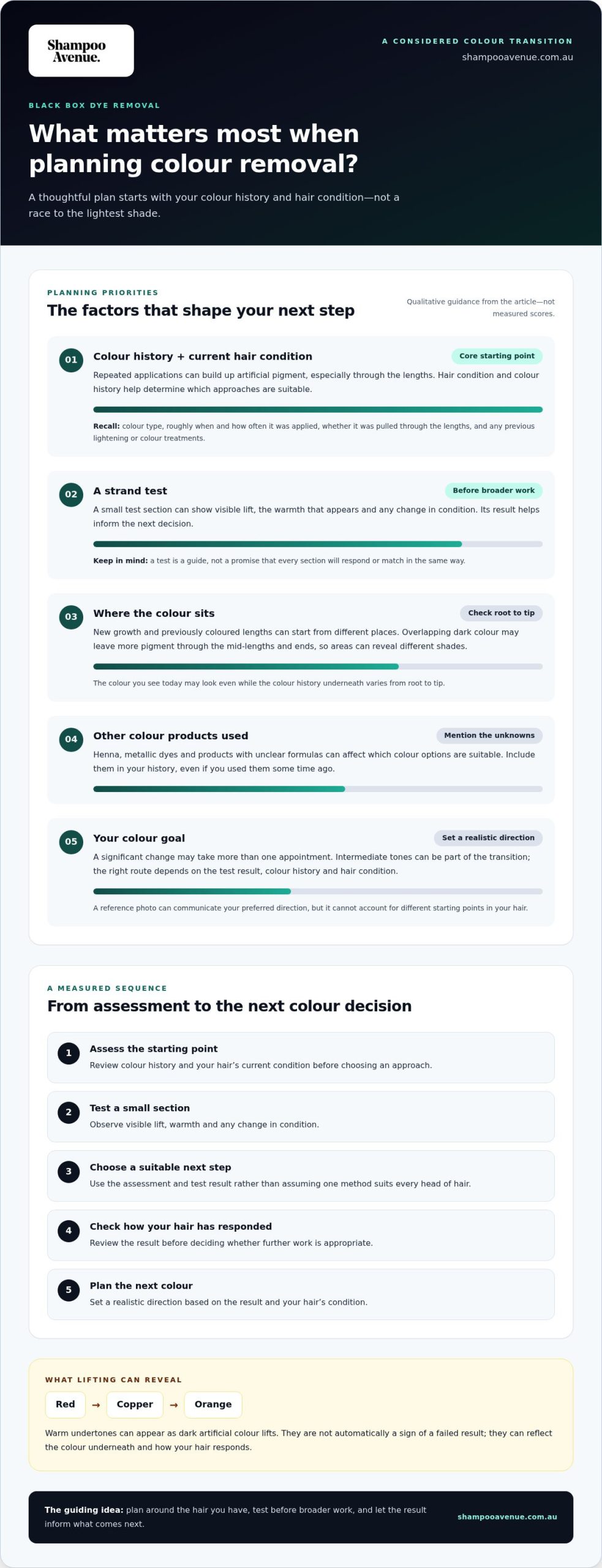
Removing dark artificial colour is best approached as a sequence of decisions, not a race to the lightest possible shade. A considered plan starts with your colour history and your hair’s current condition, then uses a strand test to inform what may be achievable. As the chemistry of permanent hair dye shows, permanent colour changes hair through a chemical process. The result of trying to remove it can’t be assumed from the shade on the box alone.
Your colour history and hair condition shape the removal plan. There isn’t one formula for how to get rid of black box dye. A test section can show how a selected approach affects that piece of hair, including how much it lifts, the warmth that appears and any visible change in condition. It helps guide the next decision, but can’t promise that every area will respond or match in the same way.
- Assess the starting point. Review your colour history and your hair’s current condition before choosing an approach.
- Test a small section. Observe how the selected hair responds, including the visible level of lift and warmth.
- Choose a suitable next step. Use the assessment and test result to inform the approach, rather than assuming one method will suit every head of hair.
- Check the result. Review how your hair has responded before deciding whether further work is appropriate.
- Plan the next colour. Set a realistic direction based on the result and your hair’s condition.
What happens during a colour assessment and strand test?
Share what you remember about home colour, how often you used it, whether you coloured the lengths again, and any previous lightening or other colour treatments. A small test section can help assess lift, warmth and visible condition before broader work is considered. Its result is a guide, not a promise of a particular shade or a guarantee that other sections will behave identically.
Why a gradual colour transition may be more realistic
If your goal involves a significant change, reaching it may take more than one appointment. Intermediate tones can be part of a thoughtful transition, but the right route depends on the test result, colour history and hair condition. A reference photo can help communicate your preferred direction, but it can’t account for the different starting points in your hair.
Warm undertones may appear as dark artificial colour lifts. Red, copper or orange tones aren’t automatically signs of a failed result. They can be part of what’s revealed along the way. The next colour decision should respond to what’s actually there, rather than forcing a quick match to an image. Protecting your hair’s condition may mean taking a slower route or adjusting the final goal.
Shampoo Avenue’s luxury colour transformations are tailored to your hair history, desired direction and condition. Repair treatments can also be considered as part of the plan, with the opportunity to reassess at each stage.
Colour Remover, Fading or Lightening: Which Option Suits Black Box Dye?
There isn’t one best method for every head of hair. Gentle fading may soften the appearance of colour, a colour remover may reduce some artificial pigment, and lightening may be considered when a larger change calls for more lift. Each option has limits, and results depend on the product, colour history and hair condition. This comparison offers general guidance, not a substitute for an individual assessment.
| Approach | Purpose | Limitations to understand |
|---|---|---|
| Gentle fading | Gradually soften the visible depth of colour. | May have limited effect on permanent black dye and can take time; it won’t reliably create a lighter, even shade. |
| Colour remover | Reduce some artificial colour pigment. | Products vary, and the result may be incomplete or reveal warmth. It won’t restore your natural hair colour. |
| Lightening | Lift pigment when the desired change requires a lighter base. | Can expose warm tones and may affect hair condition; the result can vary across previously coloured areas. |
What can colour remover do to black box dye?
Colour removers are designed to reduce artificial pigment, but they don’t all work in the same way or produce the same result. With layered black colour, removal may be partial, and the shade left behind can look warmer or less even than expected. A remover also doesn’t put your hair back to its pre-colour state. It can’t recreate natural pigment or erase the history of previous colouring.
Read and follow the directions for any product you use. Don’t assume another application will create a predictable result, and avoid mixing products or repeating treatments to force a faster change. If you’re unsure how your hair may respond, a professional assessment can help put the options in context.
When is lightening considered, and what are the trade-offs?
Lightening may be considered if your intended colour requires artificial pigment to be lifted beyond what fading or a colour remover achieves. It can reveal underlying warmth, and previously coloured sections may respond differently from new growth. Unevenness or dryness is possible, but neither outcome is inevitable. Your starting condition and the approach matter.
Bleach isn’t a quick shortcut to a clean, even shade. A professional colour transformation can be tailored to your hair’s history, current condition and desired direction, with the result checked before deciding on further work. When deciding how to get rid of black box dye, compare what each option can reasonably do, not just how quickly it might change the colour you see.
How to Prepare for Black Box Dye Removal Without a DIY Colour Mishap
A calmer colour change starts before any product is applied. Clear information about what you’ve used helps shape a plan around your hair, rather than relying on guesswork or a one-size-fits-all fix. If you’re wondering how to get rid of black box dye, preparation is a useful first step towards a more realistic result.
What information should you gather before changing your colour?
Make a simple record of the products you remember using, roughly when you used them and how often you coloured your hair. Note whether you applied colour just to the roots or pulled it through the full lengths. Include any previous lightening, henna, other colour treatments or unusual reactions. If you can, bring the packaging or a photo of the product too.
Reference images can help explain the direction you like, whether that’s a softer brunette or a lighter look. Treat them as a guide, not a guaranteed match. The lighting in a photo, its editing and your starting colour all affect how achievable that shade may be. For broader context on planning a salon colour change, explore this guide to luxury hair colour transformations.
Before using any colour product, follow the relevant product or salon process for patch and strand testing. A patch test and a strand test serve different purposes: one checks for a possible skin reaction, while the other shows how a selected piece of hair responds. Neither can guarantee an identical result across every section, so share the findings as part of your colour history.
Which at-home shortcuts should you avoid?
Resist the urge to stack bleach, colour remover and another box dye to force a quick change. If you don’t yet know how your hair has responded to one process, adding another chemical application soon afterwards can make the outcome harder to predict and may put extra strain on your hair. Follow product directions, don’t mix products, and avoid repeating an application simply because the first result wasn’t the shade you hoped for.
Household ingredients are sometimes suggested as a way to fade colour, but they can’t be relied on to remove permanent artificial pigment safely or evenly. Scrubbing or drying out your hair is no shortcut to a controlled colour result. If you’re concerned about how your hair feels, hair repair care may be worth discussing as part of a broader plan. This protein treatment and hair repair guide explains care options, though no treatment should be treated as a way to reverse all damage.
Ready to plan a considered colour change? Explore a tailored colour transformation with Shampoo Avenue, where your colour history and hair condition inform the approach.
Plan Your Next Colour with a Professional Black Box Dye Transformation
Once you understand your starting point, decide where you’d like your colour to go. A professional colour transformation considers your colour history, the shade you’re aiming for and your hair’s visible condition together. That gives the plan room to respond to what your hair can manage, rather than treating a reference photo as a promise of an exact result.
At Shampoo Avenue, luxury colour transformations are tailored to the individual. A colour discussion can explore your preferred direction, whether that’s a softer brunette, a warmer tone or a lighter look, alongside your hair’s colour history. Depending on the assessment, the plan may include a test where appropriate and may progress in stages. There’s no universal sequence, shade or timeline for everyone.
What might a personalised colour plan include?
The approach is shaped by what your hair shows and the change you’re hoping to make. It may involve discussing your goals, assessing your hair’s condition and using a test to help inform the next step. The plan can balance your preferred colour direction with your hair’s visible condition, and may be adjusted as the result becomes clearer. Shampoo Avenue uses premium professional products as part of its haircare offering.
Hair repair treatments may also be considered as part of a broader colour and hair wellness plan. They’re an option to support hair care, not a guarantee that every effect of past colouring can be reversed. The focus is on choosing considered next steps for your individual starting point.
How to take the next step with confidence
Bring your colour history and a few inspiration images to a colour discussion. Include any home colour, lightening or other treatments you remember, even if the details aren’t exact. Images help show the direction you like, while an honest conversation about your starting colour keeps expectations grounded. You don’t need to have all the answers before you begin.
A gradual result still counts as progress towards your preferred direction. If the first stage brings your hair closer to your goal while keeping its condition in view, that can be a more considered outcome than rushing towards a dramatic change. The right pace depends on your hair and the colour history it carries.
After your colour service, thoughtful care can help you maintain your new look. Find practical ideas in this guide to hair colour aftercare.
If you’re ready to explore how to get rid of black box dye with a plan shaped around your hair, explore Shampoo Avenue’s colour transformations for a considered next step.
Take Your Next Colour Step with Confidence
Your next shade doesn’t need to be decided all at once. Think of the change as a direction you can move towards, with each step guided by how your hair responds and what feels right for you. That’s a more useful starting point than chasing an instant result or comparing your hair with someone else’s. Understanding how to get rid of black box dye can help you approach the change with patience, while a personalised plan turns that understanding into practical next steps.
Shampoo Avenue specialises in luxury colour transformations, with hair repair treatments and scalp health services available as part of a broader hair wellness approach. Professional Davines products are used in the salon’s services. These options support a thoughtful colour journey without promising a particular shade or outcome.
Bring your ideas, be open about your colour history and give yourself room for a gradual transformation. Explore Shampoo Avenue’s luxury colour transformations when you’re ready to plan your next step. A considered change can still feel fresh, exciting and entirely your own.
Frequently Asked Questions
Can black box dye be completely removed?
Not always, and removal doesn’t necessarily return your hair to its original colour. The result depends on the type and number of colour applications, how your hair responds and what shade is underneath. For example, a colour remover may reduce some artificial pigment while leaving warmth or a residual tone. A realistic goal might be a softer or different shade rather than a complete reset. Shampoo Avenue can assess your hair and help shape a realistic colour plan.
How long does it take to get rid of black box dye?
There’s no set timeframe: a small change may need a different plan from moving several shades lighter. A colour transformation may involve more than one appointment, with time between stages to review how your hair responds and decide what’s sensible next. If you’re planning for an event, allow flexibility rather than expecting a particular result by a fixed date. A useful estimate depends on your colour history and hair condition.
Is colour remover safer than bleach for black box dye?
Colour remover is designed to reduce artificial pigment, while lightening products can lift artificial and natural pigment. That difference doesn’t make every remover risk-free or suitable for every head of hair. Products vary, and the result can still be uneven or warmer than expected. If your hair has been coloured repeatedly or its history is unclear, a professional assessment can help weigh the options before you apply another chemical product.
Can I bleach black box dye at home?
Bleaching layered black box colour at home can be difficult to control, so it’s not a reliable shortcut to an even result. Sections with different colour histories may lighten at different rates, and your hair may become dry or fragile. Don’t apply bleach over other recent colour-removal products to force extra lift. If you’re set on a lighter shade, have your colour history and goal assessed before taking that step.
Why has my hair turned orange after removing black dye?
Orange can appear because dark artificial colour has lifted enough to reveal warm tones beneath it, rather than exposing a pale or neutral base. Your hair may also look different from roots to ends if those areas had different application histories. Avoid immediately applying another dark dye to cover the warmth. That can add more pigment without addressing the uneven base. Have the result assessed before choosing what to do next.
Will removing black box dye damage my hair?
Some colour-removal processes can affect how your hair feels, but damage isn’t inevitable. The risk depends on its existing condition, previous chemical treatments and the approach used. Noticeable changes such as increased dryness, roughness or breakage are reasons to pause further processing and seek professional advice. Hair repair treatments may support a care plan, but they can’t guarantee that chemical effects will be reversed.
Should I colour my hair again straight after using a colour remover?
Don’t assume it’s suitable to recolour immediately. Follow the specific remover’s instructions, as products differ, and consider how your hair looks and feels after use. A strand test and professional assessment can help show how a new colour may take, especially if the result is patchy or warmer than expected. Avoid adding another box dye just to cover the result before you understand how your hair has responded.