

How to Fix Brassy Hair: Australian Colour Guide
That stubborn orange glow isn’t just your expensive salon colour fading away; it’s actually a cry for help from a compromised hair cuticle. We’ve all been there, staring in the bathroom mirror at yellow roots or rust-coloured ends that make a luxury blonde look anything but. If you’re wondering how to get rid of brassy hair without ending up with muddy, purple-stained patches, you aren’t alone. It’s a common frustration that often leads to a cycle of over-toning and straw-like texture that feels more like a chore than a beauty routine.
It’s exhausting trying to maintain that fresh, creamy tone while balancing a busy Australian lifestyle and our harsh environmental factors. You deserve a routine that feels like self-care rather than a chemistry experiment. In this guide, we’ll share professional secrets to neutralising unwanted warmth and restoring your hair’s integrity using ethical, high-performance solutions. You’ll discover the real difference between purple and blue pigments, learn how to prevent oxidation before it starts, and find a low-maintenance path to a lived-in luxury blonde that stays luminous and healthy between salon visits.
Key Takeaways
- Understand that brassiness is the result of oxidation and exposed underlying pigments, which requires a strategic neutralising approach rather than just more product.
- Learn exactly how to get rid of brassy hair by using colour theory to choose the right pigment for your specific shade, ensuring you don’t end up with muddy or purple-stained ends.
- Discover why a professional gloss service is the gold standard for restoring a fresh, creamy tone while prioritising hair health and scalp wellness.
- Master a safe at-home routine using Davines Alchemic ranges to maintain your luxury colour without the risk of over-toning or causing dryness.
- Implement simple prevention protocols, such as UV protection and the pre-beach fresh water trick, to shield your hair from the harsh Australian elements.
Understanding Brassy Hair: Why Your Luxury Colour Shifts
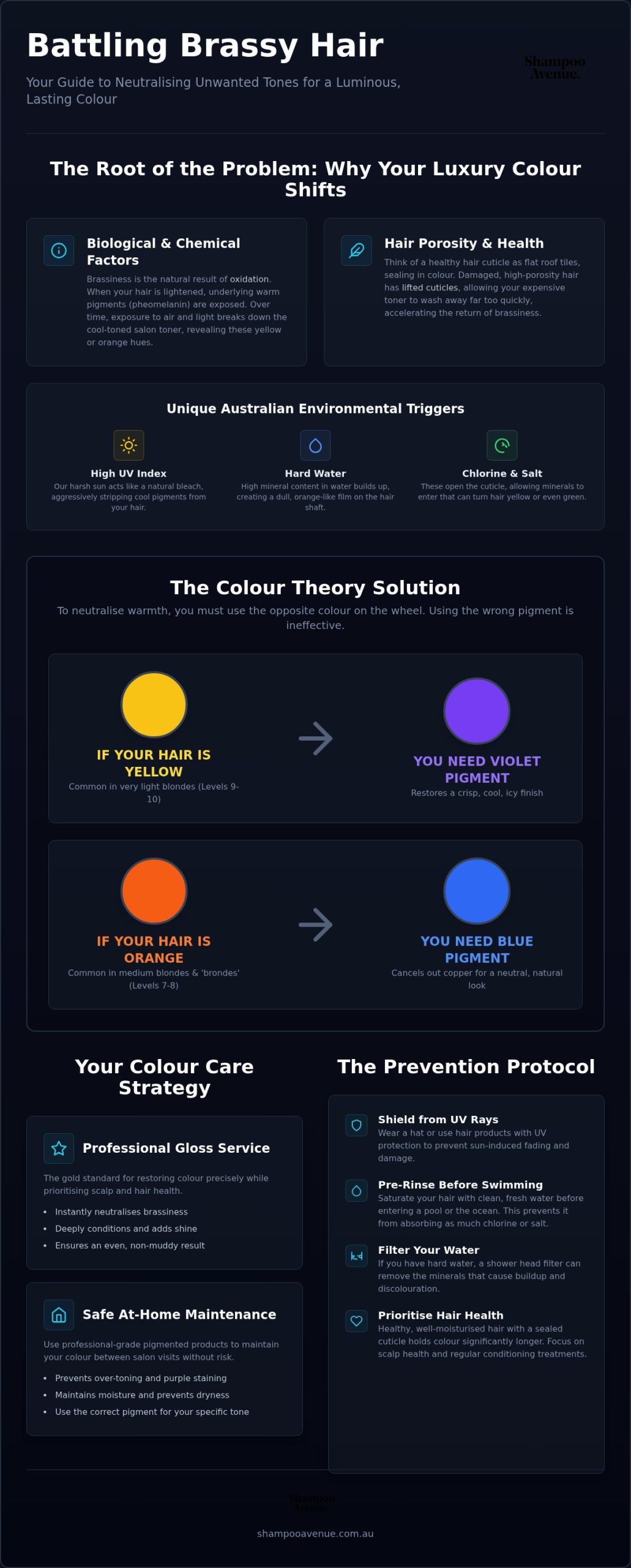
Brassiness isn’t a mistake; it’s a natural biological process. When we lighten your hair to achieve that luxury blonde or soft brunette, we lift away the dark eumelanin pigments. What remains are the underlying warm tones, known as pheomelanin. In darker hair, these are often deep reds and oranges. In blondes, they’re pale yellows. Your professional toner acts as a delicate veil that neutralises these warm shades, but it isn’t permanent. Over time, that veil begins to lift.
Oxidation is the primary reason your cool, creamy tone begins to shift. Just as a cut apple turns brown when exposed to air, your hair’s artificial pigment molecules break down when they encounter oxygen and light. This is why many clients ask how to get rid of brassy hair after just a few weeks of sun exposure or heat styling. In luxury colour, particularly lighter shades, there is less natural pigment left to anchor the toner, making the shift more noticeable. Our lived-in techniques actually embrace a touch of this natural warmth at the roots to ensure a graceful grow-out, but keeping the mid-lengths and ends crisp requires a bit of science.
The Role of Hair Porosity and Health
Think of your hair cuticle like shingles on a roof. When hair is healthy, those shingles lie flat, locking in moisture and pigment. Damaged or high porosity hair has a lifted cuticle, allowing your toner to wash away far too quickly. This is why we focus so heavily on scalp health and hair wellness as the foundation for any colour. A healthy scalp produces the natural oils needed to seal the cuticle and protect your investment. If your hair is dry or straw-like, it loses its ability to reflect light smoothly. Instead of a glossy shine, the light scatters, making even a small amount of underlying warmth look dull and “cheap.”
Environmental Triggers in Australia
Living in Australia presents unique challenges for maintaining luxury colour. Our exceptionally high UV index acts like a natural bleach, aggressively stripping the cool tones from your hair. It’s not just the sun, though. Environmental factors play a huge role in how to get rid of brassy hair effectively.
- Hard Water: Many Australian homes, especially those with older plumbing, have high mineral content. These minerals sit on the hair shaft, mimicking the look of orange brassiness.
- Chlorine and Salt: A quick dip in the pool or the surf can open the cuticle and swap your expensive toner for minerals that turn hair yellow or even a swampy green.
By understanding these triggers, you can move away from just “fixing” the colour and start protecting it from the root up. It’s about working with your hair’s natural biology rather than fighting against it every single morning.
Decoding the Colour Wheel: Is Your Hair Yellow, Orange, or Red?
To master your hair colour at home, you need to think like a professional colourist. The secret lies in a simple tool: the colour wheel. In the world of hair science, opposite shades on the wheel neutralise each other. If your hair is throwing a certain warm tone, you must apply the exact opposite “cool” pigment to cancel it out. This is why a “one size fits all” approach rarely works. If you apply a purple product to orange hair, you won’t see much change; you’re simply using the wrong tool for the job.
Every hair level has a specific underlying pigment it defaults to as your salon toner fades. Very light blondes (levels 9 and 10) default to yellow. Medium blondes and “brondes” (levels 7 and 8) reveal orange or copper. Darker brunettes (levels 4 to 6) often struggle with deep red or rust tones. When you’re searching for how to get rid of brassy hair, the first step is identifying your specific level of warmth. If you use too much pigment or the wrong shade, you risk the “dirty blonde” dilemma, where your hair looks muddy and flat instead of bright and clear.
Yellow Tones (Level 9-10 Blondes)
Platinum, ash, and very pale blondes are the most susceptible to turning a “canary yellow” over time. This happens because the very last remnants of natural pigment in the hair are pale yellow. To restore that crisp, icy finish, you need violet pigments. Violet pigments specifically counteract yellow light wavelengths by absorbing the yellow part of the visible spectrum and reflecting a neutral, cooler light. This is where a high-quality purple shampoo or mask is your best friend, provided your hair is light enough for the pigment to work.
Orange and Copper Tones (Level 7-8 Dark Blondes & Brunettes)
If you have a beautiful caramel balayage or a honey blonde, your “brass” usually looks more like a rusty orange than a soft yellow. Because orange is a deeper, stronger pigment than yellow, a standard purple shampoo simply isn’t strong enough to cut through it. You need blue pigments to neutralise orange. For those with very dark brown hair that throws deep red, you might even need a “teal” or green-based toner to find balance. Identifying these subtle shifts is the key to maintaining a luxury hair colour transformation that looks intentional and expensive.
Understanding these nuances helps you avoid the frustration of over-toning. It’s about precision rather than just saturation. Once you know if you’re fighting yellow, orange, or red, you can choose the right professional-grade products to keep your shade exactly where it should be. If you’re unsure where you sit on the level scale, a quick chat with your stylist can save you hours of guesswork in the shower.
Professional Solutions: Why a Salon Toner Beats a DIY Fix
It’s tempting to reach for a quick fix from the chemist aisle when those orange tones start peeking through. However, when you’re looking at how to get rid of brassy hair effectively, professional intervention is about precision rather than just saturation. A stylist doesn’t just “apply purple”; we look at your hair’s history, its current health, and the specific level of warmth we need to neutralise. Professional terminology matters here, too. While many use “toner” and “gloss” interchangeably, they serve different purposes in maintaining your investment.
A toner is typically a corrective tool used immediately after lightening to shift the raw, exposed pigment. In contrast, a professional gloss is a restorative, acidic treatment that adds a sheer veil of colour while smoothing the hair’s surface. DIY products often lack this nuance, leading to the dreaded “over-toning” effect: purple-stained ends and stubborn orange roots. By booking a 30-minute gloss service between your main appointments, you can maintain the integrity of your luxury hair colour without the guesswork of a home kit.
The Power of Professional Glossing
Acidic glosses are the secret weapon of the lived-in blonde look. Unlike permanent dyes that open the hair cuticle, acidic glosses live on the outside of the hair shaft, physically sealing the “shingles” we discussed earlier. This creates a “mirror effect,” where light reflects off a smooth, healthy surface. When light reflects properly, it naturally masks underlying warmth. To ensure the gloss adheres evenly, we often suggest a professional protein treatment for hair beforehand. This fills in the “potholes” in your hair’s structure, preventing the pigment from grabbing too darkly in damaged areas.
The Risk of DIY Chemical Toning
The biggest danger with home toning kits is the developer. Many “box toners” or chemist-bought dyes come with a standard 20-volume developer. On hair that has already been pre-lightened, this is far too aggressive. It can cause a “chemical haircut” or permanent staining that creates unsightly banding in your colour. When you’re trying to figure out how to get rid of brassy hair, a DIY mistake can actually set you back months. Correcting an uneven, home-toned result often costs three times more than a simple maintenance appointment at the salon. It’s always better to trust a friendly expert who understands the delicate balance of your hair’s chemistry.
Master Your At-Home Routine: How to Neutralise Tones Safely
Maintaining your tone at home shouldn’t feel like a gamble or a chemistry experiment. While we’ve explored why warmth appears, your weekly shower habits are what truly determine the longevity of your colour. To understand how to get rid of brassy hair without causing damage, you need a structured approach that prioritises hair health alongside pigment correction. Follow these professional steps to keep your shade looking salon-fresh.
- Step 1: Clarify First. Start your routine with a clarifying shampoo. This removes mineral buildup from tap water and environmental pollutants that can act as a barrier, preventing your toning products from adhering evenly to the hair shaft.
- Step 2: Choose Your Target Pigment. Not all brass is the same. Use Davines Alchemic Silver for cool blondes, or opt for Alchemic Copper or Tobacco if you are a brunette looking to manage rusty or orange undertones.
- Step 3: Emulsify for Evenness. Never apply pigmented shampoo directly to your head. Emulsify the product in your hands first to ensure an even distribution. This simple trick prevents “purple spots” or patchy results on the more porous sections of your hair.
- Step 4: Watch the Clock. Timing is everything. Leaving pigment on for too long can lead to a muddy or overly dark result. Start with three to five minutes and adjust based on how your hair responds.
- Step 5: Seal the Cuticle. Always finish with a pH-balancing conditioner. This final step is crucial to close the hair cuticle, locking the fresh pigment inside and ensuring a smooth, light-reflecting finish.
The “Purple Shampoo” Rules of Engagement
It is a common mistake to use pigmented products every single time you wash. Over-using purple shampoo can lead to a buildup of cool pigment that actually makes your blonde look darker and duller. If your hair starts looking “inky” or loses its brightness, you are likely over-pigmenting. We recommend the “Cocktail Method” for a gentler approach. Mix a small amount of your pigmented shampoo with a Davines moisturising shampoo to dilute the intensity while still providing a subtle refresh. This keeps your tone bright without sacrificing the soft, touchable texture of your hair.
Deep Conditioning with Pigment
If your hair feels dry or straw-like, a pigmented mask is far more effective than a shampoo. Shampoos are designed to cleanse, which can sometimes open the cuticle further, while masks drive moisture and pigment deep into the hair structure. For those with lightened hair, using Davines Heart of Glass Intense Treatment provides both structural repair and brightening benefits in one step. The Alchemic system uses pure pigments to deposit colour naturally without the need for silicones or parabens. To find the perfect balance for your specific hair type, explore our range of professional haircare products designed for long-lasting luxury results.
The Prevention Protocol: Keeping Your Lived-In Blonde Bright
One of the most effective habits you can adopt is the “Pre-Beach” trick. Before you hit the surf, wet your hair thoroughly with fresh tap water and apply a generous amount of a nourishing mask. Because hair is like a sponge, it can only absorb so much liquid. By saturating it with fresh water first, you prevent it from soaking up salt or chlorine that aggressively strips your colour. Be mindful of your heat tools, too. High heat literally “cooks” delicate toner molecules, turning a creamy blonde into a yellowed mess instantly. Always use a professional heat protectant and keep your tools on a lower setting to maintain that fresh finish.
Embracing a Lived-In Blonde mindset is also a game-changer. This approach focuses on a seamless blend that works with your natural warmth rather than fighting it every step of the way. It is a more sustainable, low-maintenance path that keeps your hair healthy and your colour looking intentional for months on end.
Defending Against Australian Elements
For many Australians, the water coming out of the tap is a hidden culprit. If you live in an area with bore water or old copper pipes, a shower head filter is the best $50 investment you can make for your hair wellness. It filters out the heavy minerals that mimic brassiness and make hair feel straw-like. For post-sun recovery, we love the Davines SU range, which is specifically formulated to replenish hair after UV exposure. It is also vital to know what you are fighting. While brassy hair looks orange or rusty, “chlorine green” is a chemical reaction from copper in pool water. If your blonde looks swampy rather than warm, you need a clarifying treatment rather than a purple shampoo.
The Maintenance Schedule
Consistency is the foundation of luxury hair. We recommend booking a professional gloss and a “face-frame” refresh every six to eight weeks. This mid-cycle appointment keeps your tone crisp and bright without the need for a full colour service. Don’t skip your regular trims, either. Frayed, split ends are more porous and lose pigment faster, making the bottom of your hair look dull and brassy. If you find the maintenance of a high-lift blonde is becoming too much, you might reckon it is time for a change. Transitioning to a grey blending style is a beautiful, modern way to embrace natural transitions with even less brass and a softer grow-out.
Step Into Your Best Hair Era
Mastering your tone is about more than just a quick fix. It’s about understanding the science of your specific hair level and defending it against the harsh Australian elements. Whether you’re neutralising canary yellow with violet or cooling down rusty orange with blue, the right approach preserves your hair’s integrity while keeping your shade looking expensive and clear. Remember that consistency and prevention are your best allies in the fight against oxidation.
Learning how to get rid of brassy hair safely means moving away from aggressive DIY chemicals and embracing restorative, professional-grade rituals. Ready to restore your glow? Book your luxury colour transformation or maintenance gloss at Shampoo Avenue. As lived-in blonde specialists, our team is powered by sustainable Davines professional haircare to deliver high-end colour wellness transformations. Your hair is an investment, and with a little expert care, it’ll stay luminous long after you leave the chair.
Frequently Asked Questions
Why does my hair turn brassy even if I use purple shampoo?
Your hair turns brassy because purple shampoo only addresses surface-level yellow tones and cannot stop the underlying process of oxidation. If your hair has shifted to an orange or copper shade, the violet pigment in purple shampoo is simply too weak to neutralise it. You might also have mineral buildup from tap water that creates a wall around the hair, preventing the shampoo from working effectively.
Is there a difference between purple and blue shampoo for brassiness?
There is a significant difference based on colour theory. Purple shampoo is designed for level 9 or 10 blondes to cancel out pale yellow light wavelengths. Blue shampoo is formulated with deeper pigments to neutralise the stubborn orange and copper tones found in darker blondes or brunettes. Using the wrong one can lead to muddy results, so it’s vital to identify your specific underlying pigment first.
Can hard water make my blonde hair look orange or yellow?
Hard water is a major culprit for discolouration in many Australian homes. Minerals such as iron, calcium, and magnesium found in bore water or old plumbing can deposit onto the hair shaft, creating a rusty or yellowish film. This mineral buildup often mimics natural brassiness, but it requires a clarifying treatment or a shower filter rather than more toning pigment to fix.
How often should I get a professional toner/gloss at the salon?
We recommend booking a professional gloss or toner refresh every six to eight weeks. This timeline aligns with the natural fading cycle of artificial pigments and allows us to restore your tone without the need for a full colour transformation. Regular maintenance visits ensure your lived-in blonde stays bright and creamy while keeping the hair cuticle sealed and healthy between major appointments.
Will getting rid of brassy tones damage my hair?
Neutralising brassy tones shouldn’t cause damage if you use the right methods. Professional acidic glosses actually improve hair health by sealing the cuticle and adding shine. However, if you’re wondering how to get rid of brassy hair using high-volume DIY toners, you do risk significant dryness and breakage. Sticking to professional services and nourishing, pigmented masks like Davines Alchemic ensures your hair stays strong.
Can I get rid of brassy hair if I have dark brown hair?
You can definitely manage brassiness in dark brown hair by using blue or tobacco-based pigments. Brunettes often struggle with deep red or rust-coloured undertones that appear as their salon colour oxidises. By using a professional-grade blue shampoo or a pigmented mask like Davines Alchemic Tobacco, you can neutralise those warm reflections and restore a rich, cool, and expensive-looking chocolate or ash brown shade.
What is the best Davines product for neutralising yellow tones?
The best Davines solution for yellow tones depends on your hair’s condition. For pure pigment deposit, Davines Alchemic Silver shampoo and conditioner are the gold standard for cool blondes. If your hair also needs structural repair, we recommend the Heart of Glass range. It uses a natural blue extract from the Jagua fruit to gently balance yellow tones while strengthening the hair fibre.
Does heat styling make hair turn brassy faster?
Excessive heat styling is one of the fastest ways to turn your hair brassy. High temperatures from straighteners and curlers can cook the delicate toner molecules, causing them to evaporate or shift in colour almost instantly. When researching how to get rid of brassy hair, always remember that prevention is key. Using a high-quality heat protectant and lowering your tool’s temperature will help keep your luxury colour intact for much longer.