

Fix Gummy Hair After Bleaching: Professional Guide
You’re standing at the bathroom sink after a fresh colour session, but as you run your fingers through your wet hair, your heart sinks. Instead of the silky blonde you imagined, your tresses feel like wet noodles or stretchy elastic that snaps with the slightest tug. It is a terrifying moment that leaves many wondering if their only option is a drastic buzz cut. We know how distressing it feels to see severe breakage and that mushy, gummy texture when you are just trying to look and feel your best.
The good news is that your hair isn’t necessarily a lost cause. This guide will show you exactly how to fix gummy hair after bleaching by focusing on professional structural restoration rather than just surface-level softening. You can stop the immediate shedding and start the journey toward healthy, resilient hair once again. We will walk you through the essential differences between protein and moisture needs, provide steps to halt breakage right now, and help you create a long-term wellness plan using professional techniques to restore your hair’s integrity from the inside out.
Key Takeaways
- Understand why your hair feels elastic or mushy and how severe chemical over-processing affects the internal structure of your tresses.
- Discover the immediate first aid steps to stop breakage, such as avoiding heat styling and mechanical stress while your hair is at its most vulnerable.
- Master the delicate balance between protein for structural rebuilding and moisture for flexibility to learn how to fix gummy hair after bleaching effectively.
- Recognise when at-home products aren’t enough and why professional salon bond builders are essential for deep, structural hair rescue.
- Transition to a hair wellness mindset with lived-in luxury blonde techniques that protect your hair’s integrity while keeping your colour vibrant.
What is Gummy Hair and Why Does it Happen?
Finding that your hair has turned into a soft, mushy mess after a colour session is more than just a bad hair day; it is a sign that the internal architecture of your tresses has been fundamentally compromised. When we talk about how to fix gummy hair after bleaching, we are really talking about a rescue mission for the hair’s structural integrity. Gummy hair occurs when the protective outer layer, known as the cuticle, has been effectively stripped away, leaving the inner cortex completely vulnerable and exposed to the elements.
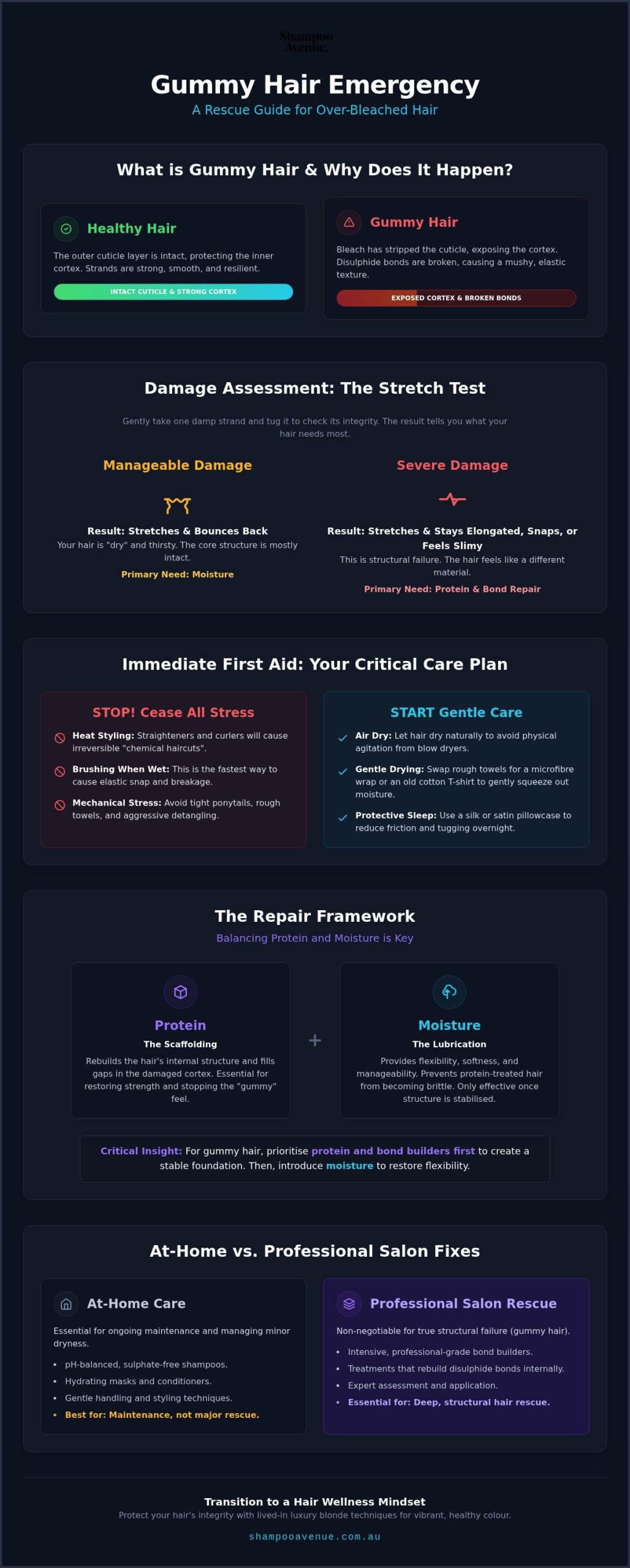
This “gummy” sensation is most noticeable when your hair is wet. Instead of feeling firm and smooth, the strands feel like wet spaghetti or elastic. If you pull a single hair and it stretches significantly without returning to its original length, or worse, snaps instantly, you are dealing with severe chemical over-processing. Understanding the science of hair bleaching helps explain why this happens. The process requires a high pH level to open the cuticle and dissolve melanin, but if the solution is too strong or left on too long, it also dissolves the essential keratin proteins and lipids that keep your hair strong and hydrated.
The Science of Bleach Damage
The chemical reaction during bleaching is aggressive. Highly alkaline chemicals work to break down the disulphide bonds, which are the tiny “bridges” that give your hair its shape and strength. When too many of these bonds are destroyed, the hair loses its “memory” and its ability to hold itself together. This leads to extreme porosity, where the hair absorbs far more water than it can handle, resulting in that heavy, mushy feel. Cortex exposure is the primary root cause behind that unsettling, mushy, and gummy texture that occurs when the hair is saturated. Without the cuticle to keep water out and protein in, the hair simply lacks the scaffolding required to stay upright.
Identifying the Severity of Your Damage
Before you can decide how to fix gummy hair after bleaching, you need to assess just how much damage has occurred. You can do this at home with a simple “Stretch Test.” Take a small section of damp hair and gently tug it between your fingers. If it stretches and bounces back, your damage is likely manageable with moisture. However, if it stretches like chewing gum and stays elongated, or if it feels slimy to the touch, the structural failure is deep.
It is vital to differentiate between “dry” hair and “structurally compromised” hair. Dry hair is simply thirsty for oils and conditioners, but it still feels like hair. Compromised gummy hair feels like a different material altogether. Identifying this early allows you to stop using standard conditioners that might actually weigh the hair down further and instead pivot toward intensive, professional-grade bond builders and protein treatments that address the root of the problem.
First Aid: What to Do After a Bleaching Disaster
If you’ve just rinsed out lightener and realised your hair feels like mush, put down the brush immediately. This is the “critical care” phase where every action counts to prevent permanent loss. Learning how to fix gummy hair after bleaching starts with doing absolutely nothing that could physically strain the hair fibre. Your hair is currently in a state of structural collapse, and the goal now is to stabilise what remains before any further breakage occurs.
Stop all mechanical stress right now. This means no brushing, no tight ponytails, and certainly no heat styling. High temperatures from straighteners or curlers will effectively melt the remaining weakened bonds, leading to instant “chemical haircuts” that cannot be reversed. Your hair needs a total break from styling to begin any form of recovery.
The ‘No-Touch’ Rule for Wet Hair
When hair is gummy, its internal structure is so weakened that it cannot support its own weight when wet. Brushing or combing at this stage is the fastest way to cause an “elastic snap,” where the hair stretches until it breaks off in clumps. You must treat your tresses like fine lace until they are dry and somewhat stabilised.
- Swap your rough bath towel for an old cotton T-shirt or a microfibre wrap to squeeze out moisture gently.
- Avoid the temptation to detangle while hair is saturated; if you must, use your fingers with extreme caution.
- Use a silk or satin pillowcase to reduce friction and “tug” on the hair while you sleep.
- Let your hair air dry whenever possible to avoid the physical agitation of a blow dryer.
Immediate Product Intervention
Your first wash following the disaster is vital for long-term survival. Switch immediately to a pH-balanced, sulphate-free cleanser that won’t further strip the few remaining lipids. This isn’t the time for supermarket “repair” shampoos that often rely on heavy waxes to create a fake sense of smoothness. Instead, you need a professional-grade protein treatment for hair to begin the reconstruction process from within the cortex.
While it’s tempting to drench your hair in heavy coconut or olive oil, please resist. These large molecules sit on the surface and add weight, which can actually snap fragile strands rather than penetrate the hair shaft. A lightweight, professional leave-in treatment is a far better choice, providing a temporary protective barrier without the heavy drag. If you’re feeling overwhelmed by the level of damage, booking a professional hair wellness consultation can help you identify exactly which bonds need urgent attention before you lose more length.
The Repair Framework: Balancing Protein and Moisture
Think of your hair as a delicate architectural structure. Bleaching has effectively knocked down the internal support beams (protein) and dried out the protective sealant (moisture). When you are researching how to fix gummy hair after bleaching, you must understand that neither protein nor moisture can solve the problem alone. A successful recovery requires a precise equilibrium. If you lean too heavily on protein, your hair becomes brittle and snaps like a dry twig. If you only focus on moisture, your hair remains mushy and lacks the “backbone” to stay strong. We often recommend the ‘sandwich’ method, which involves alternating these treatments to give your tresses exactly what they need at each stage of the repair process.
At our salon, we prioritise using professional-grade products for this framework, carefully selecting those with high-quality, sustainable ingredients that respect the hair’s natural biology. These expertly formulated treatments are designed to penetrate the cortex rather than just sitting on top of the strand. This ensures that your hair wellness journey is rooted in genuine restoration rather than a temporary, cosmetic fix.
Reconstructing with Protein
Protein is the scaffolding of your hair. When the disulphide bonds are broken, keratin and amino acids are required to fill the gaps in the damaged hair shaft. These ingredients bond to the weakened areas, providing immediate structural reinforcement. However, you must be patient with this process. For home care, a protein treatment should generally be limited to once a week. Over-using protein can lead to ‘protein overload,’ a state where the hair becomes exceptionally stiff and rough. If your hair starts to feel like straw, it’s a clear signal to pause the protein and increase your moisture intake.
Sealing with Moisture and Lipids
Once you have started rebuilding the internal structure, you must seal it with moisture and lipids. These fatty acids restore the hair’s natural water-repellent layer, which prevents water from entering the cortex too easily and causing that unsettling mushy feel. Deep conditioning masks are essential here as they provide the ‘slip’ needed to prevent tangles and further mechanical damage. To get the best results, you should learn how to use a hair mask for maximum repair, ensuring the product is evenly distributed and left on long enough to actually work its magic. This step is what brings back the softness and shine, making your hair feel like hair again rather than a chemical byproduct. Finding this balance is the ultimate secret for anyone wondering how to fix gummy hair after bleaching while maintaining long-term hair health.
Professional Salon vs. At-Home Fixes: When to Call the Experts
While at-home maintenance is vital for day-to-day management, a professional salon visit is often the only way to perform a true structural rescue. Professional-grade bond builders and concentrated reparative treatments contain smaller molecular weights that can reach deeper layers of the cortex than any retail product. If you’re struggling with how to fix gummy hair after bleaching and seeing little progress with your home routine, it’s time for help. A specialist can identify exactly where the hair is failing and provide targeted intervention that stabilises the strands far more effectively than a standard conditioner. Understanding how to fix gummy hair after bleaching requires a professional eye to distinguish between hair that can be saved and hair that must be cut.
The Salon Rescue Session
When you book a hair wellness consultation, we don’t just look at the surface. We examine the elasticity and porosity of your tresses to determine if you need intensive treatments like Davines Nourishing Royal Jelly or high-potency keratin boosters. These salon-only formulas are designed to re-bond the hair’s architecture from the inside out. One common mistake is using purple shampoo at home to fix brassiness on gummy hair. Because over-processed hair is highly porous, it can soak up pigment unevenly, leaving you with patchy violet spots. A professional toning service is much safer, as it uses acidic, non-ammonia formulas that close the cuticle while correcting the shade. Transitioning to a luxury hair colour specialist ensures your future colour goals are met without pushing your hair past its breaking point.
The Hard Truth: When to Cut
Sometimes, the damage is so severe that no amount of chemistry can fuse the hair back together. Dead ends that have completely lost their internal structure will continue to split upwards, damaging healthy hair as they go. A precision “dusting” or a more intentional haircut can actually make your hair look thicker and feel significantly healthier by removing the weight of compromised fibres. We often recommend a “lived-in” approach for clients recovering from bleaching disasters. This technique allows your natural roots to blend seamlessly with your lightened ends, reducing the frequency of chemical services. If you’re ready to start your journey back to healthy hair, you can book a professional hair rescue session with our expert team today.
The Path to Hair Wellness: Preventing Future Damage
Healthy hair grows from a healthy scalp. If your scalp is congested or neglected, the new hair emerging will lack the structural integrity needed to withstand future chemical services. Organising a regular schedule for professional scalp treatments ensures that your follicles are nourished and your new growth is as resilient as possible. Think of it as preparing the soil before planting a garden; the better the foundation, the more beautiful the results will be.
Choosing the Right Colour Method
Not all blonde services are created equal. High-impact, back-to-back foils can be incredibly taxing on your tresses, especially if they are already compromised. Instead, consider the benefits of working with a lived-in blonde specialist who uses techniques designed to reduce bleaching frequency. These methods allow your natural colour to grow out gracefully, meaning you only need to lighten your hair a few times a year. For those managing a few silver strands, grey blending offers a more natural, less aggressive transition that avoids the harsh chemicals of traditional permanent dyes. Always ask your stylist to include bond-protecting additives in every bowl of lightener to maintain your hair’s internal scaffolding during the process.
Daily Habits for Stronger Hair
Your routine between salon visits is what determines if your hair remains healthy or slips back into a fragile state. Reducing your reliance on heat styling is non-negotiable for anyone recovering from over-processing. When you do use a blow dryer or iron, always apply a high-quality thermal protector first. This creates a barrier that prevents your remaining keratin bonds from being scorched. The overall strength of your hair follicle is deeply linked to your scalp health, so treat your scalp with the same care you give your skin. We recommend using a silk wrap for sleeping to prevent mechanical breakage and friction against your pillowcase. By adopting these mindful habits, you ensure your hair stays vibrant, strong, and beautiful for the long term.
Restore Your Strength and Confidence
Gummy hair feels like a total disaster, but it doesn’t have to be the end of your blonde journey. By stepping away from the heat tools and focusing on a precise balance of protein and moisture, you can begin to rebuild what was lost. We have explored the essential steps for how to fix gummy hair after bleaching, emphasising that true structural rescue often requires professional intervention to reach the deeper layers of the cortex.
At Shampoo Avenue, our expert Australian stylists are specialists in Davines professional repair treatments and award-winning luxury colour transformations. We are deeply committed to hair wellness and helping you achieve stunning results without compromising the integrity of your tresses. You don’t have to navigate this alone or settle for a drastic cut before exploring our restorative options.
Book your Hair Wellness Consultation at Shampoo Avenue and rescue your colour today. Let’s work together to restore your hair’s health and get you back to feeling like yourself again. You’ve got this, and we are here to support you every step of the way.
Frequently Asked Questions
Can gummy hair be fixed without cutting it all off?
Yes, you can often save your length if the damage hasn’t caused total breakage. Professional bond builders and protein treatments work to stabilise the hair’s internal architecture, preventing the need for a buzz cut. While a “dusting” of the ends is usually necessary to stop splits from travelling upwards, most people can learn how to fix gummy hair after bleaching with a dedicated, professional-grade wellness plan and plenty of patience.
How long does it take for gummy hair to feel normal again?
You should expect a recovery period of at least 4 to 8 weeks before your hair starts feeling resilient again. Texture improvements happen gradually as you consistently apply the protein and moisture balance framework. While the gummy feel will subside with the right treatments, true hair wellness involves protecting your existing length while encouraging strong, healthy new growth from the scalp.
Is it okay to use purple shampoo on gummy, bleached hair?
It is best to avoid purple shampoo while your hair is in this vulnerable, mushy state. Because gummy hair is extremely porous, it soaks up cool pigments far too quickly and unevenly, which often results in patchy lilac or muddy tones. Stick to gentle, pH-balanced cleansers that focus on repair, and let a professional colourist handle any brassiness with safer, acidic toning glosses.
What is the best protein treatment for gummy hair in Australia?
We believe the Davines Nourishing range offers the best professional repair options available in Australia. These products use sustainable, high-potency ingredients that are specifically formulated to rebuild the hair’s keratin structure from within. Unlike many over-the-counter options, these salon-grade treatments provide the exact amino acids required to strengthen over-processed tresses and restore the structural integrity of your hair.
Can I dye my gummy hair a darker colour to hide the damage?
You should never use permanent hair dye or high-volume developers on compromised hair. If you want to hide the damage by going darker, a professional acidic gloss or semi-permanent colour is the only safe path. These options deposit pigment without further opening the cuticle, allowing you to improve the appearance of your tresses while you focus on how to fix gummy hair after bleaching.
How often should I use a hair mask on over-processed hair?
Most people should use a reparative hair mask once or twice a week. Applying treatments more often can lead to over-softening, which makes the gummy texture worse by making the hair too heavy. It’s important to alternate between moisture-focused masks and protein-based treatments to ensure your hair has the right mix of flexibility and strength to stop the cycle of breakage.
Does coconut oil help fix gummy hair after bleaching?
Coconut oil cannot fix the structural damage that causes gummy hair. While it’s a popular DIY remedy, coconut oil lacks the protein and amino acids needed to rebuild broken disulphide bonds. The heavy oil can also weigh down fragile strands, potentially causing them to snap. You are much better off using a professional-grade leave-in treatment that provides a lightweight, protective barrier.
What happens if I keep bleaching my hair when it’s already gummy?
If you continue to apply bleach to gummy hair, you will likely experience immediate and severe breakage. The hair’s internal scaffolding is already failing, and further chemical processing will dissolve the remaining keratin structure entirely. This often results in a “chemical haircut” where the hair snaps off near the scalp. You must prioritise structural repair and hair wellness before attempting any further lightening.