

Managing Tangled Hair: The Professional Australian Guide to Detangling and Prevention
You’re standing in front of the bathroom mirror, hairbrush in hand, staring at a stubborn knot that feels more like a bird’s nest than a head of hair. It is a moment of pure frustration that usually ends in wincing, snapping strands, and a pile of breakage in the sink. Dealing with tangled hair shouldn’t feel like a daily battle against your own reflection. We know how exhausting it is to rely on generic supermarket sprays that promise a quick fix but often leave your hair feeling dull, heavy, and coated.
We believe your hair deserves a kinder, more professional touch that focuses on long-term wellness rather than just a temporary fix. This guide shares the expert secrets to transforming matted, knotted hair into a silky, resilient mane using ethical care and restorative techniques. You’ll learn the essential link between cuticle porosity and those pesky knots, while discovering a pain-free routine that prevents future matting. We are going to walk you through the science of hair repair and the sustainable methods that will finally give you back your shine and confidence.
Key Takeaways
- Understand why raised hair cuticles and high porosity are the primary culprits behind those frustrating, stubborn knots.
- Discover the professional golden rule for managing tangled hair safely by never dry-brushing matted strands without a high-quality lubricant.
- Move from reactive brushing to proactive hair wellness with regular trims that remove the split ends responsible for catching and tangling.
- Identify the essential professional tools and ethical products, like leave-in conditioners, that act as a daily protective shield for your hair.
- Recognise when to seek a professional salon treatment to save severely matted hair through expert bond-building and restorative care.
The Science of Knots: Why Your Hair Tangles
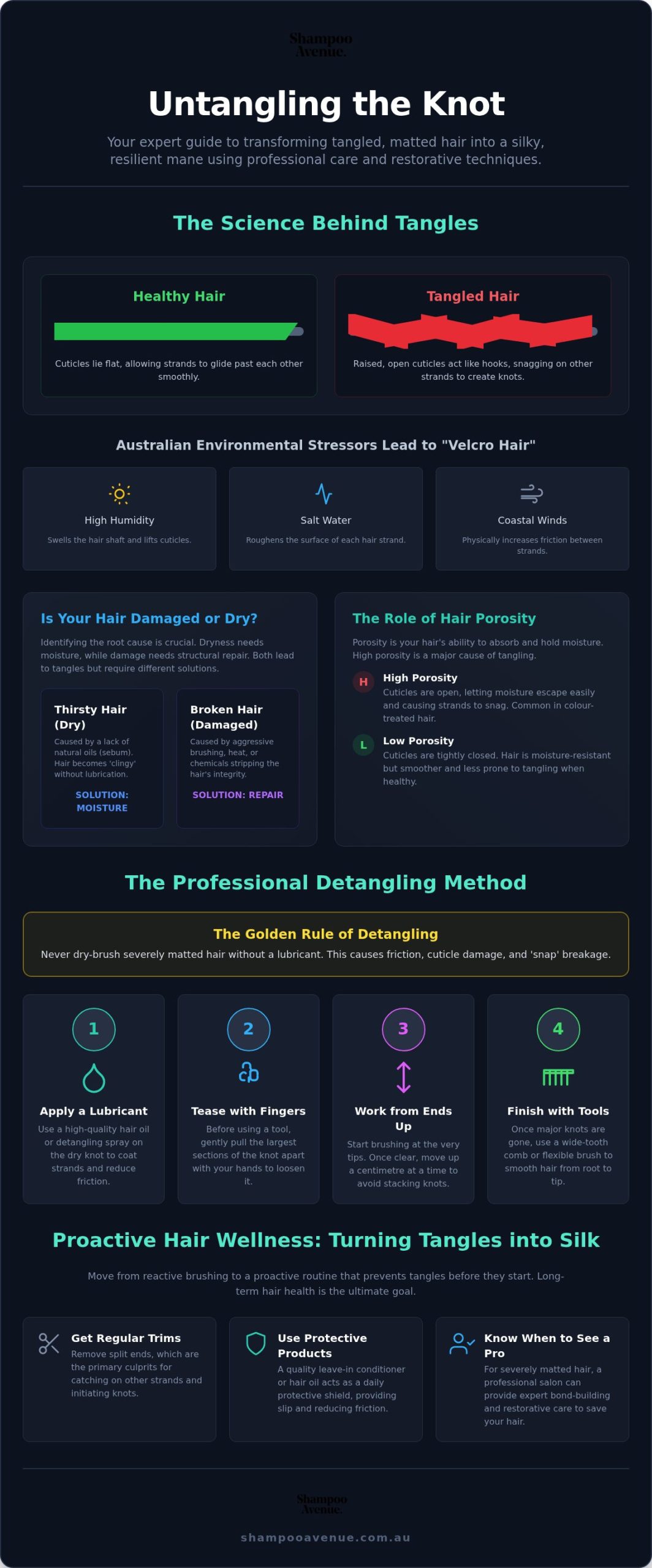
Tangled hair is more than just a morning nuisance. It’s a physical signal from your hair’s anatomy that something is slightly out of balance. At its simplest level, a tangle occurs when the outer layers of individual hair strands interlock like a series of tiny, microscopic hooks. When your hair is healthy, these layers lie flat, allowing strands to slide past one another with ease. However, when the hair is stressed, these layers lift and catch, creating the knots that cause so much frustration.
Living in Australia means our hair faces unique environmental stressors that contribute to this friction. High humidity often causes the hair shaft to swell and the cuticle to lift, while the combination of salt water and coastal winds physically roughens the surface of each strand. This creates what we call “velcro hair.” It’s a state where split ends and a chronic lack of moisture cause the hair to grab onto neighbouring strands. In rare and extreme circumstances, this neglect can escalate into Plica neuropathica, a condition where the hair becomes so severely matted that standard detangling is no longer an option.
The Role of Hair Porosity in Matting
Porosity refers to how well your hair absorbs and retains moisture. When you have high porosity, your hair cuticles stay permanently open. Think of them like open windows that let moisture out but also act as physical snags for other strands. This is especially common in colour-treated hair, where the chemical process naturally lifts the cuticle to deposit pigment. If you aren’t sure where you stand, our guide on what is hair porosity can help you self-diagnose and understand your hair’s unique needs. Understanding this link is the first step toward reclaiming a smooth, manageable mane.
Damage vs. Dryness: Identifying the Culprit
It’s vital to distinguish between hair that is simply thirsty and hair that is physically damaged. Dryness often stems from a lack of natural sebum, the oil your scalp produces to lubricate the hair. Without this “slip,” hair becomes “thirsty” and clings to itself. Damage, however, is often structural. Mechanical damage comes from aggressive brushing or tight elastics, while chemical damage, like that from over-bleaching, strips the hair’s integrity. The cuticle is the protective outer layer of the hair that must remain flat for shine. Both paths lead to tangled hair, but they require different restorative approaches to fix properly. Identifying whether you need moisture or structural repair will change your entire detangling routine.
How to Detangle Tangled Hair Without Damage
Solving tangled hair requires a shift in mindset. It’s not a chore to rush through; it’s a delicate process of preservation. If you approach a knot with frustration, you’ll likely end up with ‘snap’ breakage. This happens when the hair is pulled past its elastic limit, causing the strand to break mid-shaft. To avoid this, create a calm environment and give yourself plenty of time. Patience is the most important tool in your kit.
The golden rule of professional care is simple: never dry-brush severely matted hair without a lubricant. Without something to provide ‘slip,’ you are essentially forcing two velcro-like surfaces against each other. This friction destroys the cuticle layer we explored earlier. By following dermatologist-approved hair care tips, we know that hair is actually at its most vulnerable when saturated with water. It stretches more easily, which sounds helpful, but it also snaps with less force. Whether your hair is wet or dry, the ‘bottom-up’ philosophy is your best friend.
The Step-by-Step Professional Detangling Method
- Apply a professional lubricant: Start with a dry knot and apply a high-quality hair oil or specialised detangling spray. This coats the strands and reduces friction immediately.
- Tease with your fingers: Before reaching for a tool, use your hands to gently pull the largest sections of the knot apart. This prevents the brush from tightening the knot further.
- Work from the ends: Start brushing at the very tips of your hair. Once the bottom centimetre is clear, move up another centimetre. This prevents ‘stacking’ knots on top of each other.
- Finish with the right tools: Once the major knots are gone, use a wide-tooth comb or a flexible detangling brush to smooth the entire section from root to tip.
Wet Detangling: When and How to Do It
Sometimes, the best place to tackle a mess is in the shower using the ‘Slippery Slope’ technique. This involves saturating your hair with a rich, restorative product. We often recommend a Davines NOUNOU shampoo followed by its matching conditioner to provide the necessary glide. Comb through the hair while the product is still in, allowing the formula to act as a buffer between the strands. Finish by rinsing with cool water. This helps seal the cuticle back down, locking in that silky ‘slip’ you’ve just created. If your hair still feels unmanageable after these steps, a professional hair repair treatment can help restore the structural integrity your hair is missing.
Long-Term Prevention: Turning Tangles into Silk
Managing tangled hair doesn’t have to be a full-time job. While the techniques we’ve discussed help you navigate existing knots, the real magic happens when we shift our focus from reaction to prevention. High-quality hair wellness is about creating a surface so smooth that knots simply can’t find a place to take hold. One of the most effective ways to achieve this is through regular professional trims. When your ends are split, they become jagged and dry, acting like microscopic velcro that grabs onto neighbouring strands. By removing these damaged tips every six to eight weeks, you’re eliminating the primary catalyst for matting.
Your environment also plays a massive role in how your hair behaves overnight. While many people assume curly hair is the only type that knots easily, the science of hair tangles actually shows that straight hair can be just as prone to certain types of interlocking due to the way strands cross over one another. To combat this, consider swapping your cotton pillowcase for a silk or satin version. Cotton is a thirsty fabric that absorbs moisture and creates friction as you move. Silk allows your hair to glide effortlessly, significantly reducing the “birds nest” effect you might find in the morning. For those with longer manes, a loose braid or a soft silk scrunchie can keep your hair organised and protected during sleep or high-intensity exercise.
The Foundation of Scalp Health
We often forget that hair health starts at the root. Your scalp produces sebum, a natural oil designed to lubricate and protect the hair shaft as it grows. If your scalp is congested or out of balance, this natural detangler can’t do its job effectively. Our scalp health guide explains how maintaining a clean, nourished environment prevents build-up. When old product and dead skin cells accumulate at the root, they create a sticky foundation that leads to tangled hair further down the shaft. A healthy scalp is the first step toward a manageable mane.
Protein and Moisture Balance
Finding the right internal balance is what gives your hair the “bounce back” factor. If your hair has too much protein, it can become stiff and brittle, causing it to snap rather than slide when you try to brush it. Conversely, hair that lacks structure will feel mushy and over-stretched. You can learn how to identify if your hair requires a specialised protein treatment or a deep moisture infusion to restore its integrity. Perfectly balanced hair has the elasticity to stretch slightly and return to its shape without snapping during your daily detangling routine.
The Luxury Arsenal: Essential Tools and Products
Having the right tools is half the battle when dealing with tangled hair. While it is tempting to grab a quick fix from the supermarket aisle, those products often rely on heavy, non-soluble silicones. These ingredients might provide a temporary slippery feel, but they often coat the hair in a way that traps dryness underneath, eventually leading to more knots. Professional-grade solutions, particularly those from the Davines range, use high-quality, sustainable ingredients that penetrate the hair shaft to provide genuine nourishment and long-lasting slip.
A wide-tooth comb is a non-negotiable tool for every bathroom. It allows you to move through sections without the aggressive tension that a standard fine-tooth comb creates. For those moments during the day when the Australian wind has wreaked havoc on your style, a lightweight oil is your best friend. A few drops warmed between your palms can instantly smooth down “velcro” ends and prevent strands from catching on each other. Think of your leave-in products as a daily shield; they provide a constant barrier against the friction that causes matting in the first place. Once your hair is knot-free and smooth, finishing with a quality texturising spray can add effortless lived-in definition without weighing your strands down or causing them to re-tangle throughout the day.
Davines Favourites for Knot-Free Hair
- OI All In One Milk: This is our ultimate multi-tasking spray. It provides instant slip, making the brush glide through even the most stubborn sections, while also offering essential heat protection.
- OI Oil: Perfect for mid-day smoothing or a finishing touch, this oil smooths the cuticle and adds a reflective shine that prevents strands from interlocking.
- NOUNOU Hair Mask: For those with chemically processed hair that feels perpetually thirsty, this deep recovery treatment is essential. It restores the internal structure, making the hair significantly more resilient against tangles.
Choosing the Right Brush for Your Hair Type
Not all brushes are created equal. A boar bristle brush is excellent for distributing your scalp’s natural sebum down the length of the hair, providing a natural lubricant. However, for active detangling, you need a brush with flexible bristles that “give” when they hit a knot rather than pulling through it. One professional secret is to regularly inspect your tools. If the small plastic balls on the tips of your brush bristles are damaged or missing, the brush becomes a weapon that tears at your hair cuticle. If you’re ready to upgrade your routine, you can explore our curated selection of professional haircare products to find the perfect match for your hair’s needs.
Professional Solutions at the Luxury Hair Salon
Sometimes, despite your best at-home efforts and the most patient brushing sessions, tangled hair reaches a point where DIY methods might cause more harm than good. If you’ve spent hours with a comb only to see significant fallout, or if the matting feels like a solid mass that won’t budge, it’s time to step away from the mirror. Severe matting requires a professional eye and a gentle hand to prevent permanent loss of length. We view a salon visit as more than just a service. It is a wellness reset designed to restore your hair’s structural integrity from the inside out.
A luxury hair colour transformation is about more than just achieving the perfect sun-kissed blonde or rich brunette. It’s about the health of the canvas itself. In our salon, every complex colour service is built around essential bond-building treatments. These treatments work at a molecular level to repair the internal architecture of the hair, making each strand smoother and less likely to snag on its neighbours. Professional smoothing treatments can also be a game-changer for those struggling with chronic knots, as they eliminate frizz and tangles for months by sealing the cuticle layer into a flat, reflective state.
In-Salon Repair Treatments
Professional-only treatments are formulated with concentrated ingredients that penetrate much deeper than any standard at-home mask. While a weekly ritual at home is vital for maintenance, our intensive salon rituals use advanced bond-builders to essentially “re-glue” the damaged parts of the hair shaft. This structural support stops the hair from snagging on itself. We also frequently use a precision “dusting” technique. This allows us to meticulously remove the split ends that act like velcro without you losing any noticeable length. It’s a methodical approach that leaves your hair feeling light, organised, and incredibly soft.
The Shampoo Avenue Experience
When you walk into our space, the process always starts with a genuine, down-to-earth conversation. Our experts carefully assess your hair’s porosity and health before a single drop of product is applied. This bespoke approach ensures we aren’t just treating the symptom of tangled hair, but addressing the specific environmental or chemical causes behind it. As part of our commitment to your hair’s future, we provide a personalised hair colour aftercare plan tailored to your unique lifestyle. You don’t have to fight your hair every morning. Let us help you take the stress out of your routine so you can truly love your mane again.
Embrace the Future of Your Knot-Free Hair
You’ve now discovered that managing tangled hair is less about the strength of your brush and more about the integrity of the hair strand itself. By understanding the link between porosity and friction, and swapping generic products for professional-grade Davines solutions, you’re already on the path to a more manageable mane. Remember, the secret lies in being proactive; regular trims and consistent moisture balance are what truly turn stubborn knots into silky, resilient hair.
If your hair needs a deeper reset, our friendly team is ready to guide you. We specialise in sustainable hair wellness and professional repair treatments, ensuring your hair looks stunning while remaining ethically cared for. As experts in luxury lived-in blondes, we know exactly how to protect your colour investment while keeping it knot-free and healthy. Book your hair wellness transformation at Shampoo Avenue today and let us help you rediscover the joy of healthy hair. You deserve a routine that feels like a ritual, not a chore.
Frequently Asked Questions
Is it better to detangle hair wet or dry?
It’s generally safer to detangle hair when it’s dry and lubricated with a professional oil or milk. While wet hair has more stretch, it’s also at its most vulnerable to snapping. If you must detangle in the shower, ensure you’ve applied a high-slip conditioner first. This acts as a buffer, allowing you to move through knots without putting too much stress on the hair’s internal bonds.
Why does the hair at the nape of my neck always tangle?
The hair at the nape of your neck tangles because it’s a high-friction zone. It constantly rubs against your collars, scarves, and even your own skin, which creates heat and moisture. This combination causes the hair cuticles to lift and interlock. Keeping this area well-moisturised with a leave-in treatment can help the strands slide past each other instead of catching and matting.
Can tangled hair cause permanent hair loss?
Tangled hair doesn’t usually cause permanent loss, but aggressive brushing certainly leads to significant breakage. If you’re constantly pulling at knots, you might experience traction hair loss where the hair is physically pulled from the follicle. Over time, this can thin your hair out. It’s much better to tease knots apart gently with your fingers first to preserve your hair’s natural density and health.
How often should I use a detangling spray?
You can use a detangling spray every single day if your hair is prone to knotting. Think of it as a protective primer for your strands. Applying a professional-grade spray after every wash provides a foundation of slip. You can also lightly mist your ends between washes to refresh that protective barrier and keep your hair organised and smooth throughout a busy day.
Will a silk pillowcase really help with knots?
A silk pillowcase is one of the best investments you can make for your hair wellness. Unlike cotton, which is quite abrasive and absorbs your hair’s natural oils, silk allows your hair to glide smoothly as you move during sleep. This drastically reduces the friction that leads to morning knots and helps your professional blow-dry or style last much longer without any frustrating matting.
What is the best brush for severely tangled hair?
For severely matted hair, a wide-tooth comb or a brush with very flexible, soft bristles is the best choice. You want a tool that gives when it encounters resistance rather than one that forces its way through the knot. Avoid any brushes with rigid pins or damaged tips, as these will simply tear at the hair cuticle and create more damage for you to deal with later.
How do I know if my hair tangles are caused by damage or dryness?
You can usually tell the difference by how the hair reacts to tension. Dry hair feels rough or crunchy but still has some elasticity. Damaged hair, often from over-colouring, feels mushy when wet and snaps instantly when you pull it. If your tangled hair feels like it has no bounce back at all, you’re likely dealing with structural damage that requires a professional bond-building treatment.
Can I use a hair mask as a detangler?
Using a hair mask as a detangler in the shower is a brilliant professional trick. Because masks are more concentrated than standard conditioners, they provide an incredible amount of slip. Apply the mask to your mid-lengths and ends, then use your fingers or a wide-tooth comb to gently work through any knots while the product is still in. This nourishes the hair while making the process much smoother.