

Keratin Smoothing Treatment Benefits and How Long Results Last
A keratin smoothing treatment can reduce frizz and make hair easier to manage without making every hair type pin-straight. If you’re wondering what a keratin smoothing treatment is, it’s a chemical process that smooths the hair’s outer layer. Salon results typically last three to six months.
A keratin smoothing treatment can mean less time spent blow-drying and styling, but it isn’t the right fit for every goal or hair type. Knowing what it can change, what it won’t, and how aftercare affects the finish helps you decide.
This guide explains how keratin smoothing works, the benefits it may offer, how long results last, and how salon treatments differ from at-home options. You’ll also learn what to consider when deciding whether smoother, more manageable hair suits you.
Key Takeaways
- Smoothing treatments can help reduce frizz and improve manageability, but they don’t necessarily make hair pin-straight.
- Salon results typically last three to six months, with hair texture and aftercare influencing how long the smooth finish lasts.
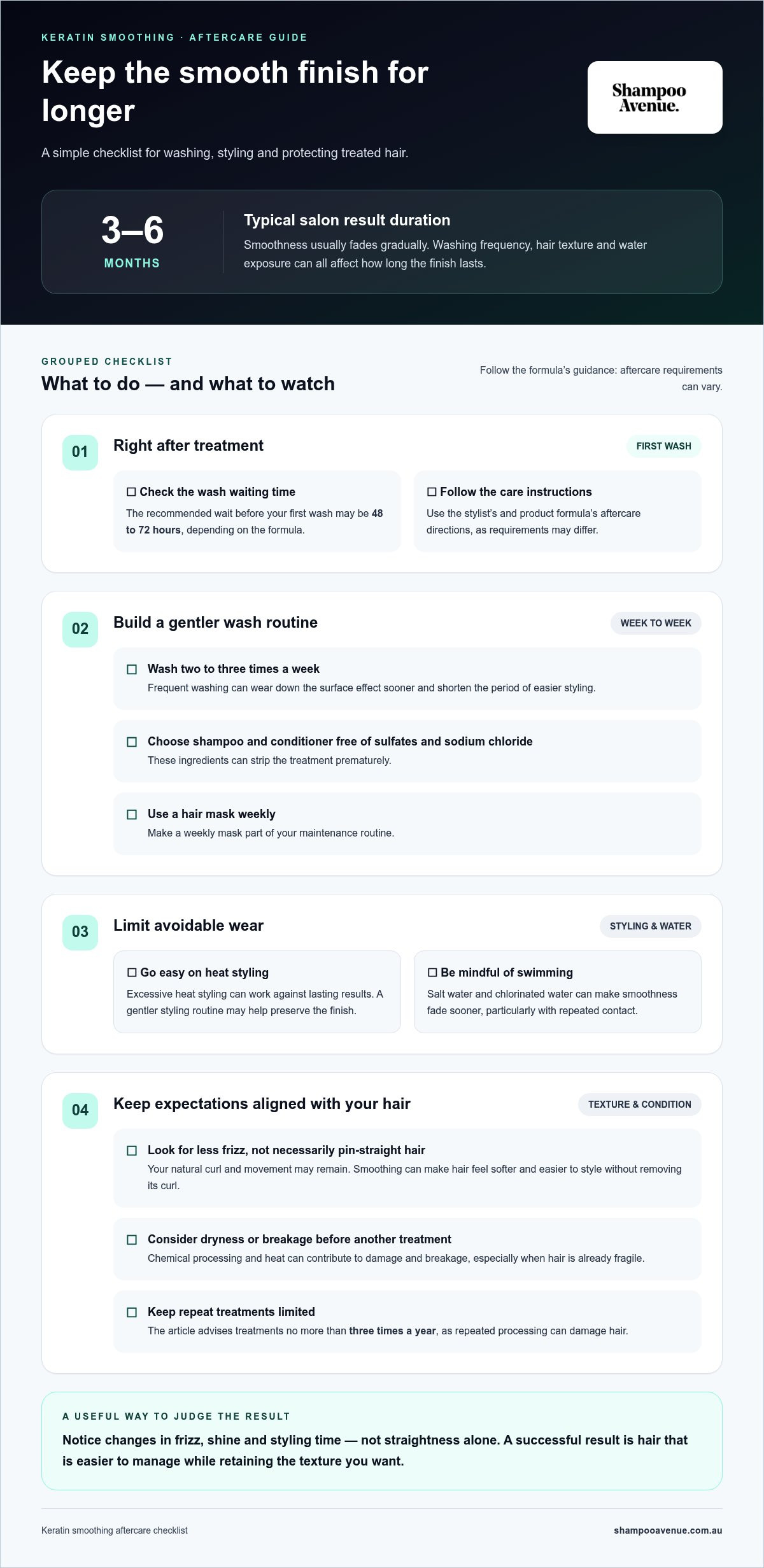
- Follow the formula’s aftercare guidance: the recommended wait before your first wash may be 48 to 72 hours.
- Salon and at-home treatments differ in application and results, so consider your hair goals before choosing between them.
- Learn how washing habits, heat styling and exposure to chlorinated or salt water can affect your treatment results.
Is keratin treatment good for your hair?
A keratin treatment can make hair smoother and easier to manage, but it doesn’t suit every hair type or styling goal. The key question is whether you want less frizz or a lasting change to your natural texture.
Choosing treatments for hair type and goals
Choose a hair treatment by matching its smoothing effect to your hair type and the finish you want. This matters if you’d like to reduce frizz while keeping your curls, rather than aiming for straighter hair.
Consider how your hair behaves in humidity, how often you style it, and whether you want to retain its natural movement. For example, if you want easier blow-drying, smoothing may suit you better than permanent straightening. Existing dryness or breakage also matters, because additional chemical processing and heat can put more stress on fragile strands. A salon application can take two to four hours, depending on hair length and thickness.
Smoothing and straightening effects
Keratin treatments are chemical processes that smooth the hair’s outer layer. Hair smoothing products are used to straighten hair or smooth curls, according to the U.S. Food and Drug Administration.
Smoother strands can look less frizzy and feel easier to style, but a keratin hair treatment doesn’t necessarily make hair pin-straight. Salon formulas can loosen a natural curl pattern, while the result still depends on the formula and how it’s applied. This distinction helps set expectations: reducing puffiness is different from removing curl. The recommended wait before washing may be 48 to 72 hours, depending on the formula.
Hair structure and internal bonds
Permanent straightening changes the hair’s structure, while keratin smoothing mainly works on its surface. Internal bonds also influence hair shape and help hold its natural pattern.
Changing those internal bonds can create a more lasting texture change, while new growth appears in its original pattern. Surface smoothing doesn’t have the same effect, although salon treatments can relax curls. This distinction matters if you want to preserve your natural texture. Chemical processing and heat can contribute to damage and breakage, so consider your hair’s condition before adding another treatment. Keratin is a protein associated with hair, but a treatment’s name doesn’t tell you every ingredient in its formula.
Keratin treatments and other smoothing options
Keratin smoothing, permanent hair straightening, and Brazilian blowouts describe different approaches, not interchangeable results. A keratin treatment smooths the hair’s surface; permanent straightening chemically changes texture, while salon smoothing may loosen curls without making them completely straight.
Ingredients vary between formulas. Some keratin treatments use formaldehyde, while others use glyoxylic acid. In Australia, the treatment name alone doesn’t establish which product requirements apply; composition and how the product is supplied matter. The U.S. Food and Drug Administration recommends checking ingredients and discussing salon safety practices to limit formaldehyde exposure. For maintenance, wash two to three times a week, use a weekly hair mask, and avoid excessive heat styling. Treatments should be done no more than three times a year, as repeated processing can damage hair.
Duration of smooth, frizz-controlled results
Smoothness usually fades gradually as the treatment wears away, rather than disappearing overnight. A professional salon keratin smoothing treatment typically lasts three to six months, so aftercare and daily habits affect how long the finish stays manageable.
Longevity of frizz control
Longevity means how long hair retains its smoother feel and reduced frizz after a salon treatment. The three-to-six-month range is a planning guide, not a fixed expiry date: washing frequency, hair texture, and water exposure all affect how quickly results fade.
Regular washing can wear down the surface effect sooner, while a gentler routine may help preserve it. Use shampoo and conditioner free of sulfates and sodium chloride, which can strip the treatment prematurely. Follow the stylist’s care instructions too, as formulas may have different aftercare requirements. For example, frequent washing may shorten the period of easier styling.
Humidity resistance and natural texture
Humidity resistance means hair is less likely to swell, frizz, or lose its smooth finish in damp air. Keratin smoothing can reduce frizz and improve manageability, but it doesn’t necessarily straighten very curly hair. Your texture still shapes the result, so curls may remain while feeling softer and easier to style.
Think of the change as frizz control, not a promise of identical results in every climate. In humid weather, treated hair may be easier to manage, while its natural curl and movement can still show. This distinction helps you decide whether you want a sleeker finish or simply less puffiness around your usual texture.
Hair may look glossier when its surface lies smoothly and reflects light evenly. As the treatment fades, that polished appearance can soften too. The finish depends on your starting texture, the treatment formula, and your washing routine, rather than a permanent change to new growth.
Salt water and chlorinated water can shorten a treatment’s life. If swimming is part of your routine, expect that exposure to affect results: repeated contact can make smoothness fade sooner. Excessive heat styling can also work against lasting results, so use a gentler styling routine where possible.
For a consistent finish, follow the formula’s aftercare directions and choose suitable shampoo. Watch for changes in frizz, shine, and styling time rather than judging results by straightness alone. A keratin treatment is working for your goal when your hair is easier to manage while retaining the texture you want.
Salon treatments versus at-home maintenance
Salon and at-home keratin treatments both aim to smooth the hair cuticle, but their formulas and application differ. A salon service typically takes two to four hours, while an at-home process usually takes one to two hours.
A professional salon treatment uses a stronger chemical process than an at-home option. At-home treatments use a lower concentration of chemicals and act on the hair’s surface rather than penetrating its internal structure. That difference affects how the treatment works, not just the application time.
An at-home keratin treatment is a chemical protein treatment that smooths the hair cuticle. It isn’t the same as conditioner: conditioner supports the hair’s feel and manageability, while a smoothing treatment changes the surface finish. The result may make styling easier, but an at-home treatment doesn’t reproduce the deeper action of a salon formula.
At-home kits are designed for use at home, but directions vary by product. Read the instructions before starting, including guidance on application, drying, and heat. The process usually involves washing and sectioning the hair, then applying the product and blow-drying. For optimal results, the instructions may call for a flat iron to seal the treatment into the hair.
Each step affects how evenly the product is applied. Sectioning helps you work through the hair methodically, while following the product directions helps avoid inconsistent coverage. Blow-drying and flat-ironing involve heat, so follow the kit’s instructions closely. Don’t assume that a method or timing from one product applies to another.
In a salon, a hairstylist typically dries the hair and uses a flat iron to seal in the treatment. Professional application can suit you if you want a more involved service or if your hair’s condition makes additional chemical processing a decision to consider carefully. Salon results typically last three to six months, while at-home treatments work on the surface and have different results.
Aftercare matters for either route. For salon-treated hair, use shampoo and conditioner free of sulfates and sodium chloride, as these can strip the treatment prematurely. The recommended wait before the first wash may be 48 to 72 hours, depending on the formula. Follow the specific product directions rather than applying salon aftercare timing automatically to a home kit.
Choose based on your goal: a salon service offers professional application, while an at-home kit provides a home-based process with a lower chemical concentration. Hair length, thickness, texture, and condition influence how the application feels and the care it takes. If your main aim is maintenance, suitable shampoo and conditioner can help support smoothness between treatments.
Treatment results and how long they last
A professional salon keratin smoothing treatment typically lasts three to six months. That range helps with planning, but the finish fades as the treatment wears away and new hair grows in. Smoothness doesn’t switch off on one set date. Instead, you may notice frizz returning gradually, particularly around the roots or through your usual curl pattern.
For ongoing results, Lily Jackson recommends treatments every 3-4 months. That timing is a guide to maintaining a smoother finish, not a reason to repeat a chemical process automatically. Treatments should be done no more than three times a year, as repeated processing can start to damage hair over time. Balance the desired frizz control with your hair’s condition and natural texture.
A salon treatment takes two to four hours, depending on hair length and thickness. That appointment time is separate from the three-to-six-month result period. Longer or thicker hair affects application time, while washing habits and formula-specific aftercare can influence how quickly the smooth finish fades.
Track results by noticing changes in everyday styling. For example, pay attention to whether blow-drying still feels easier, whether frizz returns after washing, and whether your natural texture becomes more visible. These signs show how the finish is changing without treating straightness as the only measure of success. Keratin smoothing can reduce frizz without making very curly hair completely straight.
Swimming in chlorinated or salt water can shorten a treatment’s life. If you swim regularly, that exposure may bring back a frizzy finish sooner. Washing frequency matters too: repeated washing can wear down the treatment, while suitable aftercare helps protect the surface effect. Follow the instructions for your specific formula.
- Early in the result period: notice the smoothness, shine and ease of styling.
- As the finish fades: look for frizz returning after washing or natural texture becoming more visible.
- Before another appointment: consider the time since treatment, your hair’s condition and the three-times-a-year limit.
Keratin smoothing isn’t permanent straightening. Permanent straightening chemically changes hair texture, while keratin results fade and new growth retains its original pattern. This distinction matters if you want temporary frizz control rather than a lasting texture change. If your hair feels damaged or the finish has faded unevenly, don’t treat another application as an automatic fix. Your hair’s condition and the result you want both matter when planning what comes next.
Keratin smoothing treatment benefits
Keratin smoothing treatments can help with frizz, flyaways, and hair that feels difficult to manage. They smooth the hair cuticle, creating a sleeker surface that can look glossier and feel easier to style. The practical benefit is simpler day-to-day styling, not a permanent change to your hair’s natural texture.
These treatments mainly address surface frizz, puffiness, and unruly texture. If your hair expands in humid weather or takes time to smooth after washing, a treatment can make it more manageable. Very curly hair may retain its curl pattern, so the result is smoother hair, not guaranteed straightness.
A smoother cuticle reflects light more evenly, which can make hair appear shinier. The finish can also make hair feel less rough to the touch. These are surface effects: keratin smoothing doesn’t rebuild damaged internal structure or repair split ends. For example, brittle ends still need care beyond a smoothing formula.
Styling time is another potential benefit. Keratin treatments can reduce blow-dry time by 50-60%, making the drying routine shorter for some people. Less time blow-drying can make daily styling easier, but it doesn’t remove the need to dry or style your hair. Your usual length, thickness and texture still shape the routine.
Humidity resistance can help smooth hair retain its finish in damp conditions. Keratin-treated hair is described as staying smooth in up to 90% humidity. That doesn’t mean every strand stays perfectly straight: your natural texture remains relevant, and frizz control is different from permanent straightening. Think of a softer, more controlled finish rather than a fixed look.
Consider your colour goals separately. A smoothing treatment changes the feel and appearance of the hair surface, while colour services change its shade. If you’re planning both, the order and timing can affect how you organise your appointments. A stylist can consider your current colour, hair condition, and desired finish when discussing a combined hair plan.
Use your everyday routine as a guide. If washing leaves your hair puffy or drying takes longer than you’d like, reduced frizz and easier styling may be useful benefits. If your main concern is damaged hair, focus on hair wellness and repair rather than expecting a smoothing formula to restore strength. The best outcome is the one that fits your goal.
For a smoother finish that suits your texture, discuss your frizz-control goals with a stylist.
Shampoo Avenue: Luxury Hair Colour Transformations
Shampoo Avenue can help you plan hair colour and care around the finish you want. If you’re considering smoother hair alongside a colour change, a thoughtful plan can account for both your desired look and your hair’s condition.
Choose Luxury Hair Colour Transformations, Lived-In Luxury Blonde Services or Grey Blending & Natural Colour for a change that suits your personal style. For concerns such as frizz, scalp comfort, or hair condition, Frizz Control & Smoothing Treatments and Scalp Health & Hair Wellness Treatments address different care goals.
Turn to Shampoo Avenue when you’re ready to discuss how your colour plans and hair needs fit together. Visit shampooavenue.com.au to explore your next step.
Choose a finish that feels like you
Decide what you want your hair to feel like day to day: softer and easier to style, or noticeably straighter. If you’re still considering what a keratin smoothing treatment could do for your routine, focus on your preferred texture, hair condition, and colour plans. These priorities can help you have a useful conversation about the finish you want.
Shampoo Avenue offers Frizz Control & Smoothing Treatments alongside Luxury Hair Colour Transformations, Lived-In Luxury Blonde Services, and Grey Blending & Natural Colour. This range can help you consider smoothing in the context of your broader hair goals, rather than as an isolated change. Start with the result that feels right for you.
Contact Shampoo Avenue about keratin treatments and take the next step towards a hair routine that suits you.
Frequently Asked Questions
How is the treatment applied?
A stylist applies a salon smoothing formula to clean, sectioned hair, then dries and flat-irons it. The process begins with a clarifying wash to prepare the strands for even application. The formula is worked through the hair before heat is used to seal it in. Follow the product-specific aftercare instructions afterwards, as the timing of the first wash depends on the formula.
What Is a Smoothing Treatment?
A smoothing treatment is a hair service or product designed to reduce frizz or smooth curls. The U.S. Food and Drug Administration describes hair smoothing products as being used to straighten hair or smooth out curls. The term covers different formulas and processes, so it doesn’t identify one ingredient or guarantee a pin-straight result. Check the product information to understand the treatment being used.
What are the pros and cons of keratin?
Keratin smoothing can reduce frizz, create a sleeker appearance, and make styling more manageable. Some treatments can reduce blow-dry time, which may help if drying takes up much of your routine. Trade-offs include chemical processing and heat during application. Repeated treatments can damage hair over time, so consider your hair’s condition and desired texture rather than pursuing smoothness alone.
What is a keratin smoothing treatment and how does it work?
A keratin smoothing treatment is a chemical process that smooths the hair’s outer layer. The formula is applied to the hair, then dried and sealed with heat, helping strands look smoother and feel more manageable. It doesn’t necessarily straighten hair completely or change its texture permanently. For example, naturally curly hair may remain curly but feel easier to style with less frizz.
How is a keratin smoothing treatment applied step by step?
A salon treatment follows a sequence: cleanse, section, apply, dry, and seal. A stylist typically washes the hair twice with clarifying shampoo, then applies the treatment in sections. The hair is dried before a flat iron seals the formula into it. At home, follow the kit’s instructions closely, as steps and timings can differ. Don’t transfer instructions from one product to another.
How long does a keratin smoothing treatment take and how long do results last?
A salon treatment typically takes two to four hours, depending on hair length and thickness, and results usually last three to six months. The appointment includes application and heat styling; it isn’t the same as the time needed for home maintenance. Washing habits, hair texture, and exposure to chlorinated or salt water can affect how quickly smoothness fades.
What are the risks and side effects of keratin smoothing treatments?
Potential concerns include chemical exposure and damage from repeated processing. Ingredients vary: some formulas use formaldehyde, while others use glyoxylic acid. The U.S. Food and Drug Administration recommends checking product ingredients and discussing salon safety practices with the stylist to limit formaldehyde exposure. Repeated treatments can also damage hair over time, so consider the formula and your hair’s condition.
Is keratin smoothing safe during pregnancy or for sensitive skin and lungs?
Keratin treatments aren’t recommended for pregnant people. For sensitive skin or lungs, the formula’s ingredients and salon practices are important considerations, particularly where formaldehyde may be involved. The U.S. Food and Drug Administration recommends checking ingredients and discussing salon safety practices to limit formaldehyde exposure. If you’re pregnant or have a sensitivity concern, don’t assume different formulas carry the same considerations.