

Professional Blow Dry Techniques to Learn: A Step-by-Step Guide
What if a smoother blow-dry depended less on brushing harder and more on controlling airflow, section size and tension? If your hair dries unevenly, turns frizzy or loses its shape before you’ve finished styling, you’re not alone. The professional blow dry techniques to learn start with small, coordinated choices, not complicated moves.
Preparation matters, but so does adapting your method to your hair’s texture, thickness and the finish you want. A brush that creates bounce on one hair type may not give another the same result. Using the nozzle at the right angle can also make your effort count. Get these foundations working together and a polished finish becomes easier to create and maintain.
This guide walks you through preparing your hair, organising manageable sections, directing airflow and controlling your brush. You’ll also find practical ways to adjust each step for different hair types and styles. When you’d rather leave the coordination to experienced hands, a salon blow-dry can be tailored to your hair and the finish you’re after.
Key Takeaways
- Learn which professional blow dry techniques to learn first for a more controlled, polished finish.
- See how to organise sections around your hair’s density instead of trying to dry too much at once.
- Compare brush and airflow approaches for smoother hair, added volume or naturally textured results.
- Build a safe practice routine by focusing on one section or styling skill at a time.
- Discover how a salon blow-dry can tailor brush work and the final shape to your hair.
Professional blow-dry techniques to learn first: the foundations of a better finish
A professional blow-dry is controlled drying that uses airflow, brush tension and timing to shape hair towards a chosen finish. That’s the core idea behind the professional blow dry techniques to learn first: guide the hair as it dries, rather than simply pointing a dryer at it and hoping for the best.
Each part of the process supports the next. Preparation removes excess water and makes hair easier to manage. Airflow directs the hair, while brush tension helps smooth or shape it. Timing matters too. A damp section may not hold its shape, while continuing to apply heat after it is dry adds exposure without helping the style. Aim for steady control, not force.
Your starting point will vary. Fine hair may need a lighter touch and less tension than dense hair, while curls and coils may call for a method that respects their natural pattern. Hair condition matters as well, particularly if strands feel fragile or have been coloured. Your cut also shapes the result: layers can respond differently to brush direction than a blunt line. A method that works well on one head of hair may need adjusting for another.
The dryer’s job is to move warm air across the hair in a controlled way. For a little background on the history and function of hair dryers, see the overview on Wikipedia. In practice, your aim is simpler: keep the airflow purposeful and the tool moving.
What tools do you need to learn blow-drying?
Start with a hair dryer, a concentrator nozzle and a brush suited to your hair and your goal. The nozzle narrows and directs airflow along a section, helping you focus on the hair you’re shaping instead of blowing it in every direction. Choose a brush based on your hair’s length and texture, and whether you want smoothness, bend or volume. You don’t need to master every tool at once. Learn how one brush behaves on a manageable section before adding another technique.
Why does hair preparation matter before using a dryer?
Gently press your hair with a towel to remove excess water. Avoid rough rubbing, which can leave strands more tangled and harder to control. Detangle carefully, then apply a heat protectant according to its product directions before drying. If your hair is coloured, thoughtful styling is part of caring for your overall hair routine. The hair colour aftercare guide offers related care tips.
Before you switch on the dryer, decide on your finish: smooth, lifted or naturally defined. That choice affects how you position the nozzle, where you place the brush and how much tension you use. Keep the dryer moving and work with the hair’s natural growth and fall. A calm, prepared start makes the later steps easier to coordinate.
How professional blow-dry technique works: airflow, sections and brush control
A controlled blow-dry is a sequence, not a race to get every strand dry. The professional blow dry techniques to learn bring preparation, drying, sectioning and shaping into a steady rhythm. This makes it easier to see how each small handling choice affects the finish.
Controlled airflow supports a smoother finish by guiding the hair in one direction and helping limit flyaways. Keep the nozzle close enough to direct air along the section, but keep the dryer moving and at a comfortable distance from your hair and scalp.
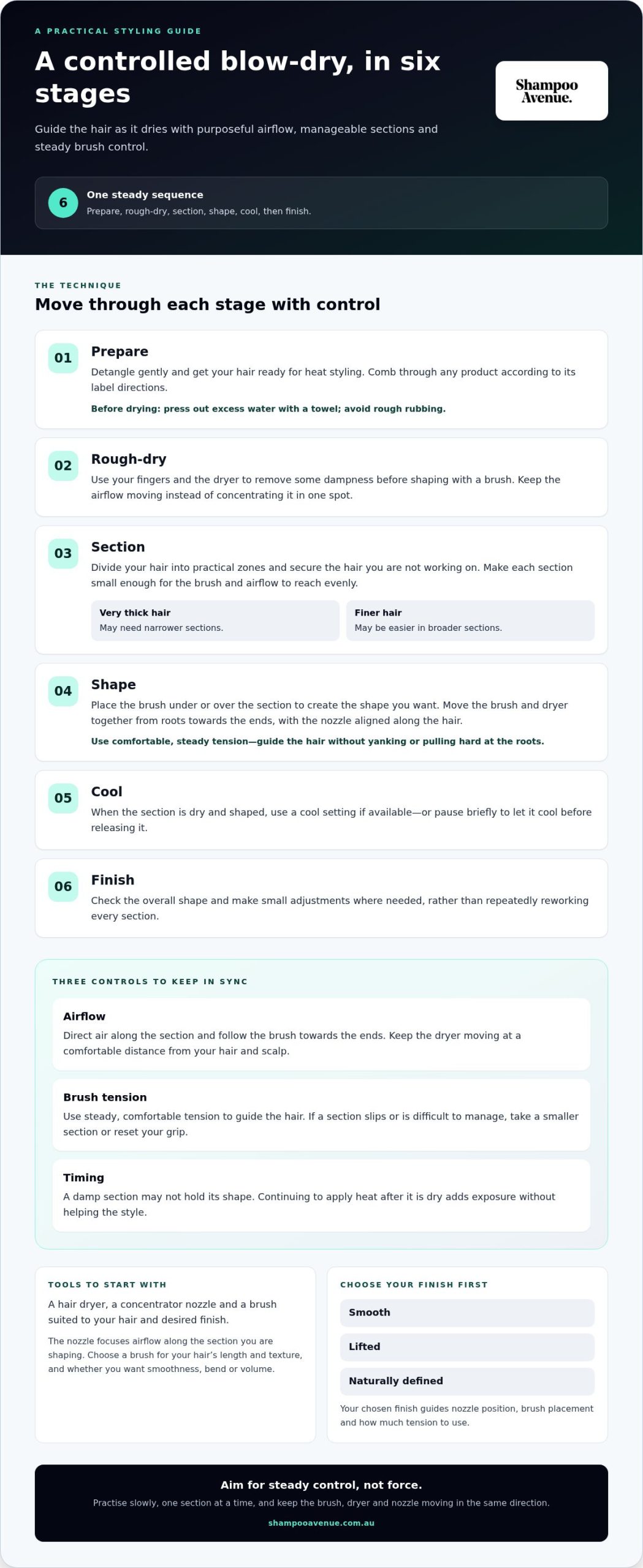
- Prepare. Detangle gently and make sure your hair is ready for heat styling. Comb through any product as directed on its label.
- Rough-dry. Use your fingers and the dryer to remove some of the dampness before shaping with a brush. Keep the airflow moving rather than concentrating it on one spot.
- Section. Divide your hair into zones and secure the sections you’re not working on. Make each working section small enough for the brush and airflow to reach it evenly.
- Shape. Place the brush under or over the section, depending on the shape you want. Move the brush and dryer together from roots towards the ends, keeping the nozzle aligned with the hair.
- Cool. Once the section is dry and shaped, use a cool setting if available, or pause briefly to let it cool before releasing it.
- Finish. Check the overall shape, then make small adjustments where needed instead of repeatedly reworking every section.
How should you section hair for a controlled blow-dry?
Divide your hair into practical zones that make the area you’re styling easy to reach. You might start at the nape if that feels easiest to control, then work upwards and leave the front until you’re comfortable managing the dryer and brush together. Adapt section size to your hair’s density. Very thick hair may need narrower sections, while finer hair may be easier to handle in broader ones. Secure unused hair loosely, without pulling at the roots.
How do airflow direction and brush tension shape the result?
Use the nozzle to direct air along the section, following the brush as it moves towards the ends. Keep comfortable, steady tension so the brush can guide the hair, but don’t yank or pull hard at the roots. If a section slips or feels difficult to manage, take a smaller one or reset your grip. Letting the shape cool before you release it gives the hair a chance to settle into place.
Practise the coordination slowly. Try one section at a time and notice whether the brush, dryer and nozzle are moving in the same direction. If you’d rather enjoy a polished finish while a stylist tailors the brush work to your hair, a salon blow-dry offers an expert styling option.
Which professional blow-dry technique suits smoothness, volume or natural texture?
The finish you want should guide how you handle the brush and dryer. Smoothness calls for controlled brush contact; volume needs lift at the roots; natural texture is best approached in a way that supports your hair’s own pattern. These professional blow dry techniques to learn are starting points, not rigid rules. Hair length, density, texture, condition and cut all affect which approach feels manageable and what result you can create.
No single blow-dry technique suits every head of hair, so match your brush work and airflow to both your hair and your desired finish. Use the comparison below as a guide, then adjust according to how each section responds.
| Finish | Brush approach | Airflow focus | Likely result |
|---|---|---|---|
| Smoother | Guide a brush steadily through manageable sections | Follow the section from roots towards ends with a concentrator nozzle | A more controlled, polished appearance |
| Voluminous | Lift the roots with the brush; direct sections away from the scalp | Dry the root area while holding the lift, then shape the lengths | Added root lift and body |
| Naturally textured | Use fingers or a diffuser to support the hair’s pattern | Distribute airflow gently without pulling the texture straight | More defined natural movement |
What blow-dry technique creates a smoother finish?
Work through controlled sections with a concentrator nozzle and a brush that can move comfortably through your hair. Keep the airflow aligned with the section as you guide the brush towards the ends, and keep the dryer moving rather than lingering over one spot. The aim is a smoother-looking finish, not necessarily pin-straight hair. Blow-drying alone also shouldn’t be treated as a permanent solution for frizz.
How can brush work create volume or preserve natural movement?
For lift, place the brush near the roots and raise the section as you dry it. Direct the hair away from the scalp before shaping the lengths. To preserve natural texture, use your fingers or a diffuser and avoid brushing in a way that disrupts the hair’s pattern. If your hair feels weakened or damaged, styling is only one part of care. The protein treatment and hair repair guide explores repair considerations.
Let comfort and control shape your choice. If a brush catches, a section feels too heavy or your hair isn’t responding as expected, reduce the section size or change your approach rather than adding more tension. A professional stylist can tailor brush work and the finish to your hair’s individual texture, condition and cut.
How to practise professional blow-dry techniques safely, step by step
A steady routine makes it easier to learn what your hands are doing without rushing the finish. Start with one small section, practise coordinating brush and dryer movement, then check the result before moving on. These professional blow dry techniques to learn are skills to build gradually: control comes before speed, and a repeatable approach helps you spot which adjustment works for your hair.
Use heat protectant, keep the dryer moving and don’t concentrate heat on one area. Choose a comfortable setting, hold the dryer at a comfortable distance and follow the tool manufacturer’s instructions. If your hair or scalp feels uncomfortably hot, stop and let it cool before continuing.
What is a beginner-friendly blow-dry practice routine?
Practise the same simple movement on one manageable section before attempting a full, fast blow-dry. Once you can guide the brush and dryer together without pulling or losing control, repeat the action on another section. There’s no need to style every part of your head in one practice session. Focus on learning how the tools move together.
- Prepare your hair. Gently detangle, apply heat protectant according to its directions and organise your tools so you can reach them easily.
- Choose one section. Pick an area you can see and comfortably reach, and keep the rest of your hair secured loosely out of the way.
- Practise the movement. Guide the brush through the section while directing the dryer along it. Keep both tools moving, and use only enough brush tension to guide the hair.
- Check the result. Feel whether the section is dry, then look at its shape. If it’s still damp or hasn’t taken the shape you intended, adjust your brush placement or section size before trying again.
- Cool and review. Let the section cool before handling it further. When you’re ready, move to another area and practise the same movement before changing technique.
How can you reduce unnecessary heat and handling?
Use a heat setting that feels manageable and suits your hair, and keep the dryer moving throughout the section. Avoid repeated passes over hair that’s already dry, forceful brushing at the roots or holding the nozzle close to your scalp. If your arm feels tired or your grip becomes awkward, pause and reset rather than compensating with more tension. Follow the dryer’s instructions for use, including any guidance on attachments and settings.
Let comfort be your guide. If you feel heat building on your scalp or a section seems difficult to handle, stop, allow it to cool and resume only when comfortable. A smaller section or slower pace may make the movement easier to control.
Learning at home can be a satisfying process, but you don’t have to coordinate every tool alone. For a polished result shaped around your hair, book a salon blow-dry with Shampoo Avenue.
When a professional salon blow-dry can help you achieve your desired finish
Home practice may be enough for a finish you can create comfortably with your own tools and routine. A salon blow-dry can help when you’d like a more polished result, find it tricky to coordinate brush and dryer, or want the styling approach adapted to your hair. The professional blow dry techniques to learn are useful foundations, but an experienced stylist can adjust them as they work.
At Shampoo Avenue, hair styling and blow-dry services are shaped around the individual, with attention to hair wellness as well as the look you’re after. Your length, density, texture, condition and cut all affect how a section behaves, so brush choice and technique can be adapted rather than applied as a one-size-fits-all routine.
What can a stylist tailor during a professional blow-dry?
A stylist can select brush work and section sizes to suit your hair and desired finish. They may focus on a smoother shape, lift through the roots or movement that works with your natural texture, adjusting the direction and tension as each section responds. Premium professional haircare is part of the salon’s product approach, with product choices guided by your hair’s needs and product directions.
That individual adjustment can be especially useful if your hair feels difficult to manage at home or you’re unsure which finish works best with your cut. You can share what you like and what you’d rather avoid, so the styling direction feels considered and comfortable.
How can you maintain your blow-dry between washes?
Protect the shape from avoidable moisture and friction. Damp conditions can disturb a styled finish, while rough contact during sleep or when changing clothes may flatten or tangle sections. Small, gentle habits can help keep the style looking settled without repeatedly restyling it.
- Keep hair dry when showering, and avoid unnecessary exposure to steam or moisture.
- Reduce friction where practical, such as by handling hair gently before bed and when getting dressed.
- Choose haircare suited to your hair and follow each product’s directions, especially when refreshing or restyling.
How long a finish lasts can vary with your hair, the weather and your routine, so focus on care that feels manageable rather than trying to preserve every strand perfectly. If you’d enjoy expert styling tailored to your hair and preferred finish, you’re warmly invited to explore Shampoo Avenue’s hair styling services.
Make your next styling session your own
Your next step doesn’t need to be a complete routine overhaul. Choose one detail to focus on, such as how the brush feels through a section or which finish makes you feel most like yourself. Treat each styling session as a chance to notice what your hair responds to, then adjust gently. The professional blow dry techniques to learn are most useful when they help you feel more at ease with your own hair, not when they turn styling into a test of perfection.
If you’d prefer to enjoy the finished look while a stylist shapes the approach around you, explore Shampoo Avenue’s hair styling services. The salon’s hair-wellness-focused approach and professional Davines haircare support considered styling, with brush work tailored to your hair and the result you’re after.
Book a blow-dry with Shampoo Avenue for styling tailored to your hair and the finish you want.
Frequently Asked Questions
What does the cool shot button do on a hair dryer?
The cool shot button directs cooler airflow over your hair after shaping. For example, use it on a curled-under end or lifted root area before releasing the brush, then check whether the section has cooled. It’s a finishing step, not a replacement for thoughtful sectioning, suitable heat settings or steady brush work. Button function can vary between dryers, so follow the manufacturer’s instructions for your model.
Can you blow-dry hair when it is very wet?
You can begin drying very wet hair, but removing excess water first usually makes styling easier to manage. Gently press your hair with a towel, detangle carefully and then start drying. Hair that’s saturated can take longer to shape, and brush work may feel awkward while strands are heavy with water. Let the hair’s condition and the finish you want guide how damp it should be before styling.
How often should you use heat protectant when blow-drying?
Use heat protectant before each heat-styling session, following the product’s directions for amount and application. For instance, check whether the formula is intended for damp or dry hair rather than assuming all products work the same way. Distribute it as directed, avoiding heavy application in one spot. It’s one part of careful styling; don’t rely on it to make excessive heat or repeated passes harmless.
Is a concentrator nozzle necessary for a blow-dry?
No, a concentrator nozzle isn’t essential for every finish, but it can make directed brush styling easier by focusing airflow on a particular area. It may suit a defined, smoother shape, while a diffuser can be more useful if you want to support natural curls or waves. Check that an attachment is designed for your dryer and fit or remove it according to the manufacturer’s instructions.
Why does my hair go frizzy after blow-drying?
Frizz after drying can relate to your hair’s texture, humidity, product choices or handling during styling. Notice when it appears: does it affect the whole head, or mainly the ends and hairline? That can help you review your approach without repeatedly applying heat. If frizz is a persistent concern, a stylist can help tailor haircare and styling choices to your hair’s needs.
Can you learn professional blow-dry techniques at home?
Yes, you can practise foundational skills at home. The professional blow dry techniques to learn include controlling a section, coordinating your tools and checking how the result responds. Try practising one small area in front of a mirror so you can see your brush position. Different hair types may need different handling, so progress at your own pace. A stylist can also demonstrate an approach suited to your hair and preferred finish.