


Bond Repair Hair Treatment: Olaplex vs K18 and How to Choose in 2026
The treatment with the biggest name may not be the one your hair needs. If you’re weighing up Olaplex vs K18, the right bond repair hair treatment depends on your hair’s condition and what may be contributing to the damage, not just the label. It may support hair affected by chemical or styling stress, but it can’t erase every sign of damage or guarantee that breakage will stop.
Conflicting claims can make the choice feel harder. Bond repair, protein and conditioning treatments are often discussed together, yet they have different aims, and no single option suits everyone. If your hair is lightened, brittle or breaking, it’s understandable to want a clear answer before adding another treatment to your routine.
This guide explains what bond repair treatments aim to address, where their limits are, and how Olaplex and K18 differ in salon care, without declaring a universal winner. You’ll also learn how these treatments compare with protein and conditioning care, what to ask your stylist, and how to support your hair afterwards. At Shampoo Avenue, a conversation about your hair history, condition and goals can help shape suitable repair and ongoing hair wellness care.
Key Takeaways
- A bond repair hair treatment may support hair affected by chemical services, heat and everyday wear, but it can’t reverse every kind of damage.
- Compare Olaplex and K18 by their treatment approach and your hair’s needs, rather than assuming one brand is right for everyone.
- Before choosing care, note your colour and chemical history, where breakage occurs, and how often you use heat or style your hair.
- Ask your stylist what a treatment is designed to address, how it fits with colour services, and what home care may help maintain your hair.
- Shampoo Avenue offers hair repair and wellness treatments, with care choices guided by your hair’s condition, history and goals.
What does a bond repair hair treatment actually do?
A bond repair hair treatment is designed to support aspects of the hair’s internal structure that may be affected by chemical processing, heat or everyday wear. Depending on the formula and your hair’s condition, it may help hair feel stronger or more manageable. It can’t return damaged strands to an untouched state.
Colouring and lightening can change the hair fibre, while repeated heat styling, brushing and friction may contribute to roughness, dryness or breakage. These signs can have different causes, so one treatment won’t necessarily address them all. Think of bond repair as one possible part of hair care, not a reset button.
What hair bonds have to do with damage
Hair is made largely of keratin proteins, arranged in a structure that includes the cortex, the inner part of the hair fibre. Different bonds help give the fibre its shape and strength. Some chemical services can affect bonds within the hair; the effect depends on the service and process. You can explore hair’s keratin structure for a simple overview.
Products described as bond repair don’t all work in the same way. Ingredients and claims vary, so check what a specific treatment is designed to support rather than assuming the label guarantees a particular result.
Bond repair, protein, and conditioning: are they the same?
No. Bond-focused treatments are marketed to support aspects of the hair’s internal structure. A protein treatment for hair uses protein or protein-derived ingredients to help improve the feel or appearance of the hair fibre. Conditioning treatments mainly help smooth the hair’s outer surface, which can make strands feel softer and easier to detangle.
These aims can overlap. A product may claim to condition while also supporting strength or repair, so check its directions and ingredient information. If your hair feels dry, rough or fragile, a stylist can assess its condition and discuss whether bond-focused care, protein, conditioning or a combination may suit your needs. The right choice depends on your hair and goals, not just the name on the bottle.
How do Olaplex and K18 salon treatments differ?
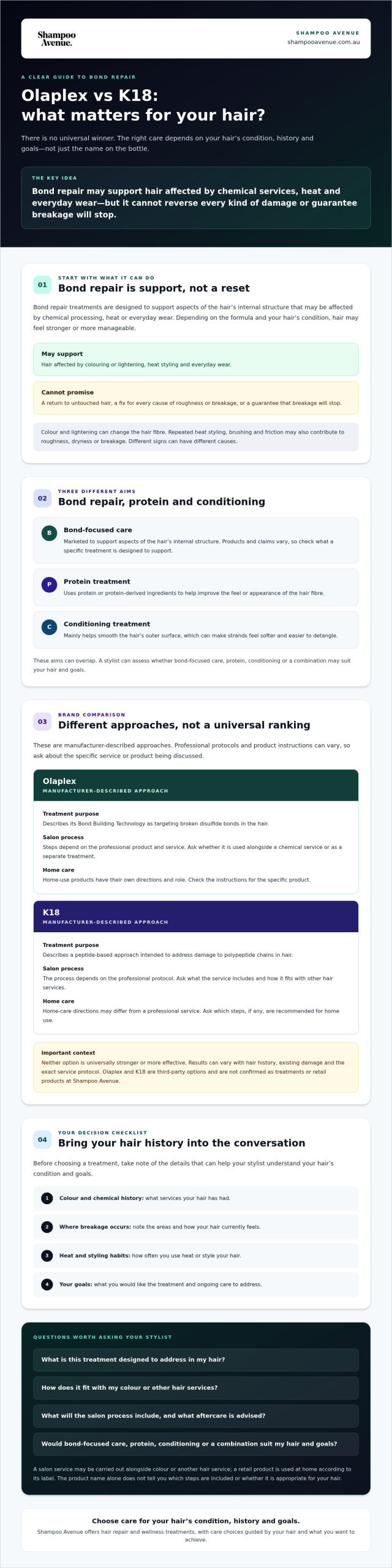
Olaplex and K18 are third-party hair-care options with different manufacturer-described approaches. Comparing them can help you ask more useful questions, but neither is confirmed as a treatment or retail product at Shampoo Avenue. Consider a bond repair hair treatment in light of your hair’s history, current condition and the exact service protocol, rather than choosing by brand name alone.
What should you compare between Olaplex and K18?
The table summarises each brand’s broad approach. Product instructions and professional protocols can vary, so check the current manufacturer guidance for the specific product or salon service being discussed.
| What to compare | Olaplex | K18 |
|---|---|---|
| Treatment purpose | Olaplex describes its Bond Building Technology as targeting broken disulfide bonds in the hair. | K18 describes a peptide-based approach intended to address damage to polypeptide chains in hair. |
| Salon process | The steps depend on the professional product and service. Ask whether it’s used alongside a chemical service or as a separate treatment. | The salon process depends on the professional protocol being used. Ask what the service includes and how it fits with your other hair services. |
| Home care | Home-use products have their own directions and role. Check the instructions for the specific product rather than assuming they match salon steps. | K18 also has home-care products, with directions that may differ from a professional service. Ask which steps, if any, are recommended for home use. |
| Suitability questions | Ask whether the approach suits your chemical and colour history, current hair condition and goals. | Ask the same questions, including how the stylist would account for existing damage and your styling habits. |
Does a salon treatment differ from at-home care?
It can. A salon service may be selected and carried out alongside a colour or other hair service, while a retail product is used at home according to its label. The name alone doesn’t tell you which steps are included or whether a product is appropriate for your hair. Ask what the treatment is intended to do, how it will be applied, and what aftercare is advised.
Neither option is universally stronger or more effective. Results can vary with hair history, existing damage and the exact service protocol. If you’re unsure what your hair needs, a stylist can discuss its condition and your care goals. You can also explore hair repair options at Shampoo Avenue without assuming the salon uses either brand.
Is Olaplex or K18 better for damaged or colour-treated hair?
Neither brand is automatically the right choice just because it’s popular. Olaplex and K18 describe different approaches, but the best fit depends on what your hair has been through, how it feels now and what you want help with. A bond repair hair treatment may be one consideration, not a guaranteed answer to every concern.
Dryness, rough texture and breakage can have different causes. Hair may feel dry because it needs conditioning, while breakage could relate to chemical processing, heat, friction or several factors together. A stylist can assess your hair and discuss options without assuming every concern calls for the same branded treatment.
Which treatment questions matter after bleaching or colouring?
Give your stylist the full picture, even if a service was done at home or some time ago. Mention recent colour or lightening, at-home chemical treatments, how often you use heat, and where or when you notice breakage. These details help you discuss treatment timing alongside your colour plan, rather than treating repair and colour as separate decisions.
It can also help to discuss your hair colour aftercare routine, including how your hair behaves between washes and after styling. Ask what a proposed treatment is intended to address, whether it fits with the planned colour service, and what ongoing care may help your hair feel more manageable.
Hair history matters more than brand popularity: choose care around your hair’s condition, past services and goals.
When might a stylist recommend a different kind of care?
If the main concern is dryness or roughness, conditioning care may be worth discussing alongside repair-focused options. If the ends are splitting or catching, a trim may help remove those ends, though it won’t address the cause of damage further up the hair. These options can complement a broader care plan, but neither should be treated as a guaranteed fix.
Scalp discomfort is separate from damage to the hair lengths. Tell your stylist if you’re experiencing persistent irritation or sensitivity; they can help distinguish a hair-care question from one that may need advice from a healthcare professional. Don’t try to diagnose the cause from a treatment label.
At Shampoo Avenue, hair repair and wellness care can be discussed in relation to your colour history, hair condition and goals. Olaplex and K18 aren’t confirmed as salon services or retail products there, so ask about the available options and what each is designed to support.
How to choose a bond repair hair treatment for your needs
A useful choice starts with your hair, not a product claim. Before booking a bond repair hair treatment, make a few notes and take them to your stylist. This gives you both a clearer starting point for discussing what may suit your hair and what to expect.
- 1. Describe what you notice. Is your hair snapping, tangling, feeling dry or losing softness? Note where the concern shows up, such as around the ends or through lightened sections, and whether it changes after washing or styling.
- 2. Write down your hair history. Include recent colour, bleaching, straightening and other chemical services, plus any at-home treatments or products you’ve used. Be honest, even if you’re not sure what a product was called.
- 3. Track your styling habits. Mention how often you use hot tools, blow-dry your hair or brush it while wet. These details can help your stylist understand the different stresses your hair may experience.
- 4. Check treatment suitability and timing. Ask whether the treatment suits your hair’s current condition and how it fits with planned colour services. If you’re considering lightening or another chemical service, discuss the order and timing with your stylist rather than guessing.
- 5. Agree on a realistic goal and aftercare. Ask what change the treatment is intended to support, how often it’s recommended, what home care is suggested and when to review how your hair feels.
What to tell your stylist before a treatment
Use everyday language. “My ends catch when I comb them” or “my hair feels rough after washing” is useful information. Share whether you’ve noticed snapping, tangling, dryness or a change in softness, and when it began. Then ask: “Does this treatment suit my hair as it is now, and will it work with the services I’m planning?”
How to set realistic expectations and maintain results
Ask what the treatment may help with and what it can’t promise. A treatment may support a particular aspect of your hair’s feel or condition, but it can’t guarantee that all damage will disappear or prevent future breakage. Your stylist can talk through home care, heat habits and suitable follow-up timing based on your routine and hair goals.
If you’re also looking into hair repair treatments for damaged ends, remember that different concerns may call for different care. A trim or conditioning routine might be discussed alongside repair-focused options, depending on your hair.
Information about hair repair care with Shampoo Avenue can help you understand the salon’s hair wellness services.
Discuss salon hair repair options with Shampoo Avenue
Choosing a bond repair hair treatment is only one part of caring for fragile or processed hair. Shampoo Avenue offers hair repair treatments, hair wellness services and colour transformations, supported by professional haircare expertise. A stylist can talk through your hair’s condition, colour history and goals before discussing which available care may suit you. Olaplex and K18 aren’t confirmed as salon services or retail products, so ask about the options the salon does offer.
What to expect from a personalised hair-treatment conversation
Bring the details that help explain what’s happening: recent colour or lightening, at-home chemical services, heat-styling habits and the changes you’ve noticed. You might say your ends tangle easily, your hair feels rough after washing or certain sections seem more fragile. Clear, everyday descriptions are useful; you don’t need to know the technical cause.
Your stylist can consider those concerns alongside your plans, such as maintaining a blonde result or changing your colour. Recommendations depend on an individual assessment, so ask what a suggested treatment is intended to support, whether it suits your current hair condition and how it fits around future colour services. It’s fine to ask about the steps involved and what kind of feel or manageability you might reasonably expect.
Build a simple repair-focused hair-care plan
Good care needs to fit real life. Alongside a suitable salon service, ask about everyday habits that may help you look after your hair, such as choosing appropriate professional haircare, reducing unnecessary heat styling and handling tangles gently. Your stylist can also discuss how often to review your routine and whether a treatment should be timed around an upcoming colour appointment.
Keep expectations grounded. A treatment may support your hair’s feel or condition, but no single service can promise to undo all existing damage or prevent future breakage. If your needs change, revisit the plan rather than adding products or services without checking whether they’re suitable.
Shampoo Avenue focuses on solving individual hair concerns, connecting hair repair and wellness care with your colour history and personal goals. The salon’s hair care information explains the services available.
Choose care that works with your hair
The best bond repair hair treatment isn’t automatically the most talked-about one. Olaplex and K18 describe different approaches, and neither is right for every head of hair. Your colour and chemical history, current condition and everyday styling habits are better guides than brand popularity.
Keep expectations realistic, too. A treatment may support how your hair feels or behaves, but it can’t promise to undo all damage or stop every instance of breakage. A thoughtful conversation with a stylist can help you understand what your hair may need and how treatment choices fit around colour services and home care.
Shampoo Avenue offers hair repair treatments and hair wellness services, using professional Davines haircare and focusing on individual hair concerns. Share what you’ve noticed and what you’d like to achieve, then explore suitable options together. Explore hair care at Shampoo Avenue and take a considered next step towards care that feels right for you.
Frequently Asked Questions
What is a bond repair hair treatment?
A bond repair hair treatment is designed to support aspects of the hair’s internal structure that may be affected by chemical services, heat or everyday wear. The formula and intended use vary by product, so check the instructions and claims for the specific treatment. It may help improve how hair feels or behaves, but it can’t return damaged hair to an untouched state or guarantee that breakage will stop.
Is Olaplex or K18 better for damaged hair?
Neither is automatically better for everyone. Olaplex and K18 describe different approaches, and suitability depends on your hair’s history, current condition and the service protocol. Tell your stylist about colour or chemical treatments, heat styling and where you notice breakage. Ask what the proposed option is intended to support and how it fits your goals. Neither brand is confirmed as a service or retail product at Shampoo Avenue.
Can bond repair treatments fix bleached or colour-damaged hair?
They may support some aspects of hair feel or condition, but they can’t erase all damage from bleaching or colouring. The result depends on factors such as your hair’s history, current condition and the treatment used. Share when and how your hair was lightened or coloured, and mention dryness, roughness or breakage. A stylist can discuss suitable care alongside your colour plan, without promising a complete repair.
How often should you use a bond repair hair treatment?
There isn’t one schedule that suits every treatment or every head of hair. Follow the directions for the specific product, and ask your stylist how often it makes sense given your hair’s condition and other services. A professional salon protocol may differ from home-care instructions. If your hair feels unusually coated, stiff or different after use, pause and check the product directions or seek advice before repeating it.
Can you use a bond repair treatment with a protein treatment?
Possibly, but check the instructions and ask a stylist before combining them. Products marketed for bond repair and protein care can have different purposes, and some formulas may address overlapping hair-care goals. Consider the exact products, how often each is used and how your hair responds. Rather than layering treatments by default, explain your routine and concerns so your stylist can help you decide whether both are appropriate.
What happens if you use a bond repair treatment too often?
There’s no single response that applies to every formula, but using a treatment more often than directed may leave your routine out of balance or cause an unwanted feel. Follow the product’s directions rather than assuming more frequent use means better results. If your hair feels coated, stiff, rough or harder to manage, stop using the product for now and check its instructions. Ask a stylist for advice if the concern continues.
Can a salon recommend a bond repair treatment for my hair?
Yes. A stylist can discuss your hair’s condition, colour and chemical history, styling habits and goals before suggesting suitable care. Shampoo Avenue offers hair repair treatments and hair wellness services, and uses professional Davines haircare. Recommendations depend on individual assessment, so share what you’ve noticed and ask how a treatment fits with planned colour services. Olaplex and K18 aren’t confirmed as options at Shampoo Avenue.